Two weeks of no school sounds like a gift. Then day one arrives, the bus does not come, the therapy hours shift, and the plan everyone was relying on quietly disappears. That gap is where most spring break stress starts, and it is one of the most common questions families bring to our ABA therapy services in the weeks before a break.
Here is the short version. Autism and routine are closely connected because predictable sequences reduce the mental load of guessing what happens next. When school breaks remove that structure, many autistic children respond with dysregulation, resistance, or increased sensory sensitivity. The fix is not a packed itinerary. It is a light framework: a visual plan for the day, advance warnings before every change, planned sensory downtime, and a lowered bar for what counts as a good day. Families who build that framework before the break starts usually get a calmer week than families who improvise on day one.
Why Autism and Routine Get Tested Hardest During School Breaks
School is a machine of predictability. Same drop-off, same lunch slot, same faces, same order. Break removes almost all of it at once.
Research points to why this matters. Intolerance of uncertainty, the tendency to react negatively to unpredictable situations, is elevated in autistic children and closely tied to anxiety. Caregiver interviews published in Autism describe how uncertainty in daily life shapes family decisions, from outings to meals. Around half of autistic children meet criteria for a clinical anxiety condition, so an unpredictable week is not a small ask. The CDC notes that autism spectrum disorder commonly involves differences in how a person responds to change and sensory input, which is exactly what a break week amplifies.
What families commonly see over break:
- Loss of the routine that carried the whole day
- Long stretches of unstructured time with no clear anchor
- Harder transitions between activities and outings
- Shifted sleep and screen habits
- Sensory overload in crowded, unfamiliar places
These are predictable responses to change. They are not misbehavior, and reading them that way usually makes the week worse. The same holds for an uptick in stimming and self-regulation behavior, which often increases when a day loses its shape.
Build the Week Before the Week Starts
The best spring break planning happens while school is still in session.
An autism visual schedule is the highest-value item on this list. Visual supports are recognized as an evidence-based practice by the National Clearinghouse on Autism Evidence and Practice at the University of North Carolina, and they work at home, not only in classrooms. A pilot study led by Marion Rutherford, published in the International Journal of Environmental Research and Public Health, found that families given structured coaching in home visual supports reported meaningful gains in confidence and use.
Keep it simple. A strip of six pictures on the fridge beats a laminated hour-by-hour chart nobody maintains. The American Academy of Pediatrics notes that children do best when routines are regular and predictable while still leaving room for choice, and that balance is the whole target.
Before break begins:
- Draw or photograph a basic daily sequence, then post it where your child already looks
- Hold wake, meal, and bedtime windows steady even when everything else loosens
- Preview the week with pictures or one plain sentence per day
- Gather the sensory tools that actually help, including noise-canceling headphones for loud environments
- Pair anything demanding with something preferred right after it
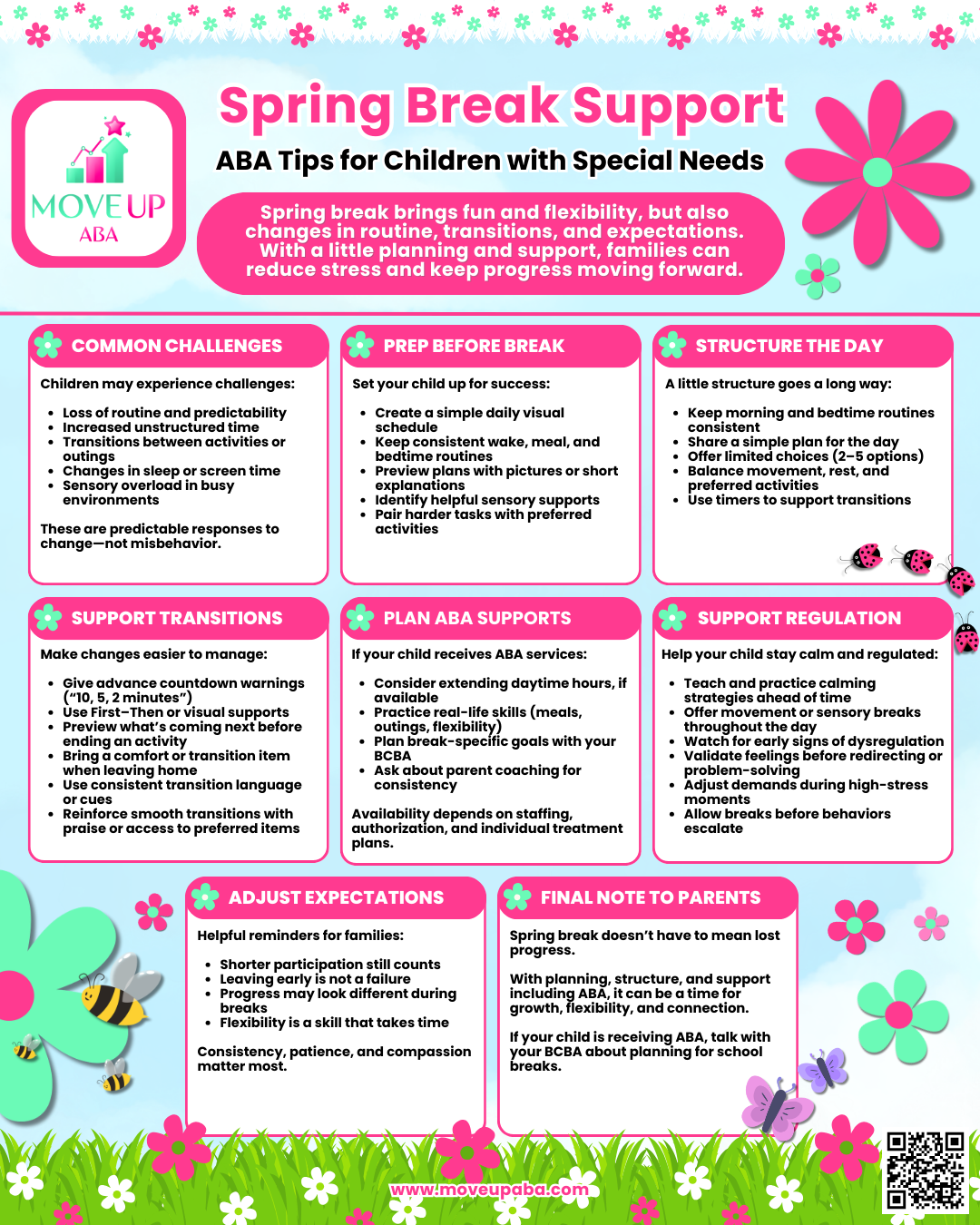
We built a one-page Spring Break Support sheet that condenses all of this into something you can print and stick on the fridge. Download the spring break sheet 📁 and keep it somewhere visible for the week. More printable parent tools live on our resources page. 🔗

Structure the Day and Soften Every Transition
A workable break day has three or four anchors and open space between them. Morning routine, one out-of-house activity, quiet time, dinner routine. That is enough. Offer two to five options instead of an open-ended “what do you want to do,” alternate movement with rest, and use a visible timer so time passing is something your child can see.
Transitions are where most break days come apart. Ending a preferred activity is a demand even when the next thing is fun. Clinicians at Brown University Health point out that autistic children often miss the subtle cues signaling a change is coming, which is why explicit signals matter so much more than usual during an unstructured week.
A first then board is a two-slot visual showing the current activity and the one that follows. It is easy to make, easy to carry, and it removes the guesswork. Advance warnings do similar work: a study in the Journal of Applied Behavior Analysis examined visual schedules alongside function-based intervention during transitions, building on earlier findings that a two-minute warning reduced transition-related behavior.
What tends to help:
- Countdown at ten, five, and two minutes, every time
- Preview the next activity before ending the current one
- Use the same transition phrase all week so the cue becomes familiar
- Bring a comfort item for the trip home
- Reinforce the smooth transitions, not only the difficult ones
Families already working with a behavior analyst can fold these into existing goals. In-home ABA therapy is often the easiest setting to practice break-specific routines, since the routines live in the home anyway. Ask early about whether daytime hours can shift when school is out, since availability depends on staffing, authorization, and the individual treatment plan.
Plan for Autism Sensory Overload Before It Happens
Break weeks pull families into busier places than usual. Crowds, noise, and unfamiliar layouts stack up fast. Seattle Children’s Autism Center notes that withdrawal, repetitive behavior, and escalation during change are usually driven by anxiety rather than defiance, which is a useful frame when a day starts sliding.
Build the exits in advance:
- Practice one or two calming strategies while your child is calm, not mid-escalation
- Schedule movement or sensory breaks into the day rather than waiting for signs of trouble
- Watch for early dysregulation and adjust demands before behavior escalates
- Validate the feeling first, then problem-solve
- Choose sensory-friendly shopping hours or off-peak times for errands and outings
What a Real Break Week Looks Like
Here is a composite from the kind of week our team sees often.
A family plans four outings across a nine-day break. Day two ends with a meltdown in a parking lot. The parents pull back to one outing every other day, add a picture strip to the fridge, and start giving countdowns before leaving anywhere. By day five the child is checking the fridge unprompted each morning. Two outings get cut short and the family leaves early both times. That is not a failed week. Shorter participation still counts, and leaving early is a skill, not a surrender.
Progress over a break looks different from progress during a school term. Some skills hold, some wobble, and flexibility itself takes time to build. Tracking helps more than remembering. A simple ABC data sheet can show whether a rough afternoon was about the activity, the transition, or the environment, and one week of rough notes gives your BCBA more to work with than a month of general impressions.
Autism and routine do not have to be at odds with a week off school. A visual plan, consistent warnings, planned downtime, and realistic expectations turn an unstructured stretch into something workable, and sometimes into a genuinely good week.
If break weeks keep going sideways in your house, our clinical team can walk through what a break-week plan would look like for your child, including which routines are worth protecting and which ones can flex. For families in Maryland and Virginia, send us your calendar through the contact page and we will build from there.
FAQs
Why do autistic children struggle with school breaks?
Breaks remove the predictable structure of the school day all at once. Autistic children often react strongly to uncertainty, so the loss of routine can show up as anxiety, resistance, or dysregulation.
How do I keep autism and routine stable during spring break?
Hold wake, meal, and bedtime windows steady, and post a simple visual plan for the rest of the day. Three or four daily anchors are usually enough.
How to deal with change in routine autism?
Give advance warning before every change, preview what comes next, and use the same transition language each time. Consistency in how you signal change matters more than the content of the plan.
Is routine good for autism?
Yes. Predictable routines reduce the cognitive load of anticipating what happens next, which lowers anxiety and makes transitions easier to manage.
Should ABA therapy continue during school breaks?
Many families keep or expand services during breaks, though availability depends on staffing, authorization, and the treatment plan. Ask your BCBA well before the break starts.
Sources:
https://pmc.ncbi.nlm.nih.gov/articles/PMC9014769/
https://www.cdc.gov/autism/index.html
https://ncaep.fpg.unc.edu/wp-content/uploads/EBP-Report-2020.pdf
https://pmc.ncbi.nlm.nih.gov/articles/PMC10001844
https://www.brownhealth.org/be-well/children-autism-and-change-tips-make-transition-easier
https://pmc.ncbi.nlm.nih.gov/articles/PMC2695333/
https://www.seattlechildrens.org/clinics/autism-center/the-autism-blog/dealing-with-change/