The nursery is painted. The bag is packed. And somewhere down the hall, a child who thrives on knowing exactly what comes next is about to have their entire day rewritten by a seven-pound stranger.
Preparing an autistic child for a new baby means teaching the new routine before it starts, rehearsing it in small pieces, reinforcing the behaviors you want to see, and protecting one-on-one time after the baby comes home. That is the short version. In ABA therapy, the principle is called front-loading predictability. Most of the difficulty families run into is not about the baby at all. It is about the sudden loss of a schedule that used to be reliable.
Why Preparing an Autistic Child for a New Baby Starts Months Early
A newborn changes three things at once: the sound level, the schedule, and the amount of adult attention available. All three matter.
Noise is the one parents underestimate. In a study of 4,104 autistic people published in the Journal of Autism and Developmental Disorders, Tana B. Carson and colleagues at Florida International University found that roughly 60 percent currently showed sensitivity to noise. A crying infant at 3 a.m. is not a background event for a child with that profile. Building in sensory breaks now gives your child a coping tool that already works before it is needed.
Schedule matters just as much. Predictable daily routines do real regulatory work, and a newborn dismantles them overnight unless you plan otherwise. The CDC describes behavioral approaches as among the most established interventions for autism precisely because they work by shaping what happens before and after a behavior. A due date gives you months of “before” to work with.
Before Arrival: Build the Routine and Write a Social Story for a New Baby
Start six to eight weeks out. The goal is that nothing about the first week home is brand new.
- Preview the baby on video. Short clips of infants sleeping, feeding, crying, and being changed. Crying belongs on that list. It is the sound most likely to trigger distress later.
- Practice the future schedule now. If bath time will move to 7:30 p.m., move it this month, not the week you come home.
- Rehearse waiting in small doses. Set a timer for 60 seconds during play. Reinforce calm waiting. Extend gradually.
- Assign a helper job early. Handing over a diaper becomes a source of praise instead of a source of competition.
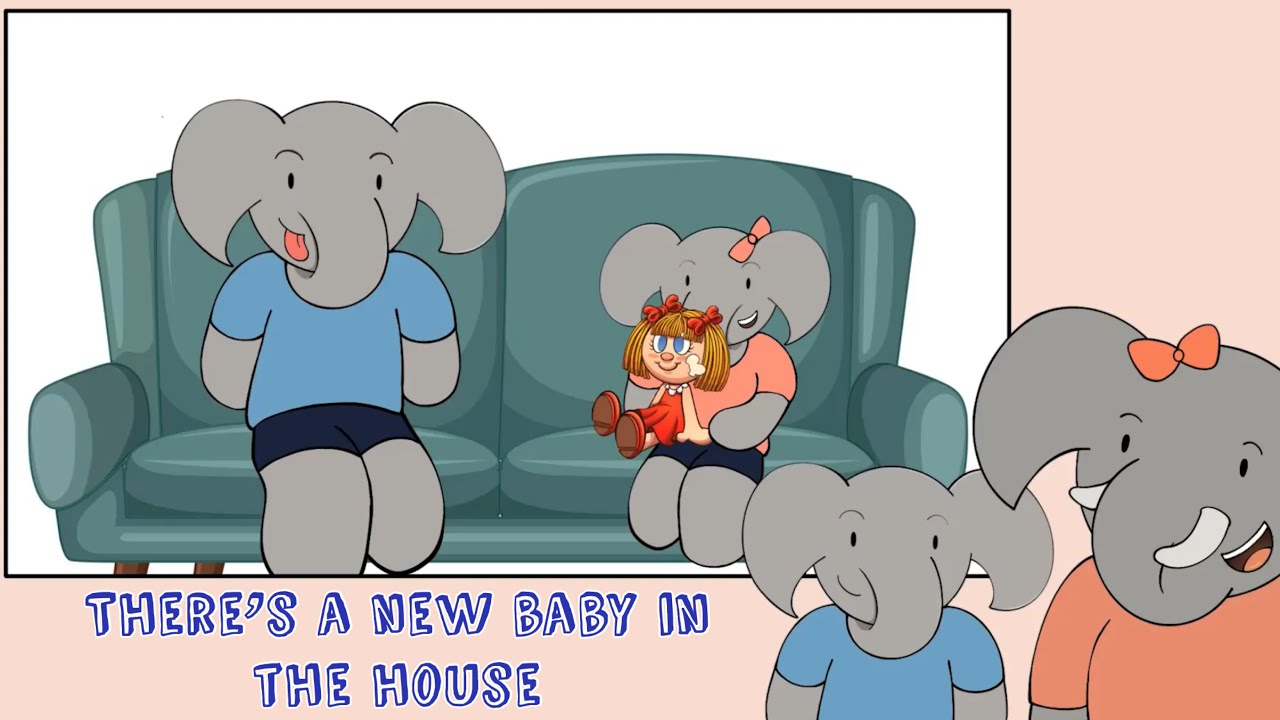
A social story for a new baby is a short, first-person narrative describing what will happen and what your child can do. “The baby will cry. Crying means the baby needs something. I can go to my quiet corner or ask for headphones.” This is not a soft strategy. Social narratives were classified as an evidence-based practice for autistic learners in the 2020 review led by Jessica Steinbrenner and Kara Hume at the University of North Carolina’s Frank Porter Graham Child Development Institute, supported by 20 single-case design studies. Read it nightly. Keep it under ten sentences. Add photos once the baby is home.
After Arrival: Helping an Autistic Child Adjust to a New Sibling
Helping an autistic child adjust to a new sibling comes down to four moves in the first eight weeks.
Keep predictability visible. Timers, picture schedules, and a posted “who is doing bedtime tonight” card carry a household through the weeks when nothing else is stable. Visual supports cleared the evidence-based practice threshold with more than 100 single-case studies behind them, and the same visual strategies you already use at home apply directly here.
Reinforce the interactions you want more of. Catch the gentle touch. Catch the quiet voice near the bassinet. Praise specifically: “You used soft hands with your sister.” Vague praise teaches nothing.
Protect one-on-one time and put it on the calendar. Fifteen scheduled minutes beats two unpredictable hours.
Expect some backsliding. The American Academy of Pediatrics notes that temporary regression in toileting, sleep, or language is a normal response to a new sibling. In autistic children it may also look like more scripting or a return to behaviors that had faded months ago.
Sibling Jealousy in Autism: Four Skills That Prevent It
Sibling jealousy in autism often shows up as behavior rather than words, which is exactly why skill-building beats waiting it out. Four targets are worth working on before the due date.
- Functional communication. Words, signs, or pictures for “I need help,” “too loud,” and “my turn.” A 2025 meta-analysis of 34 single-case studies led by Kwang-Sun Cho Blair at the University of South Florida found large reductions in challenging behavior when children were taught a communicative replacement. Strengthening communication skills reduces the need to communicate through behavior.
- Waiting and turn-taking. Practiced through games, not through crises.
- Flexible transitions. Moving between baby care, play, and shared attention without a full stop. Frequent transitions between activities get harder when a child has no reset button, so give them a safe, low-stimulation space nobody follows them into.
- Safe body behaviors. Soft touch and respecting the baby’s space. Observational research on early sibling interactions in autism dyads found more negativity in the pairs studied, which makes teaching this explicitly worth the effort rather than assuming it will develop on its own.
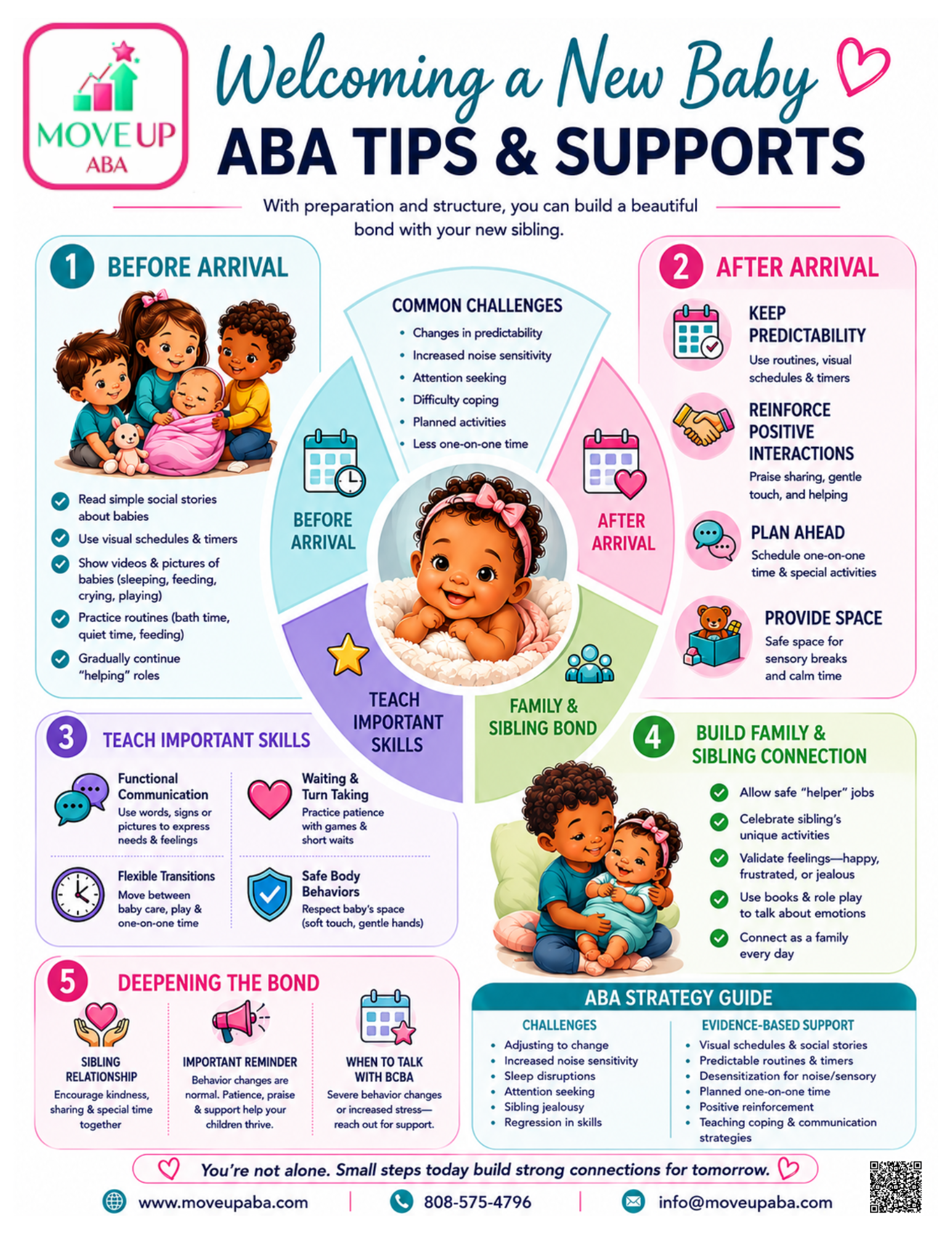
Everything above fits on a single sheet, and a sheet on the refrigerator door is easier to follow at 2 a.m. than an article on your phone. Download the Welcoming a New Baby: ABA Tips and Supports guide 📄, which lays out the before-arrival checklist, the after-arrival supports, the four skills to teach, and the signs that warrant a call. Print one for your partner and one for whoever helps with childcare, so everyone is running the same plan. More printable tools for families are collected on our resources page 🔗.
A Real-World Example, and When to Loop In Your BCBA
One Maryland family we worked with had a six-year-old autistic son and a baby due in March. He had two known triggers: sudden loud sounds and losing his mother’s evening reading time.
Eight weeks out, the team built a social story about the baby, added a recorded infant-cry track played at low volume during preferred activities, and moved his reading slot from bedtime to 5:15 p.m. so it would survive night feedings. His father took over that slot on alternating days.
The first three weeks home were not silent. He requested headphones eleven times. That was the point. He asked instead of escalating, and the 5:15 slot never moved.
Not every response follows the same shape. Studying 168 families, Louise Rixon and Richard Hastings found that sibling relationship quality varied widely by profile rather than one predictable pattern. Your child’s first month is not a verdict on the relationship. Bring it to our behavior analysts when changes are severe, when they persist past six to eight weeks, when sleep collapses entirely, or when safety around the baby becomes a concern. Families across Maryland and Virginia often add a short-term goal to an existing plan rather than starting over.
You are not adding a baby to a fixed system. You are rewriting a routine, and routines can be rewritten on purpose instead of by accident.
Send a message to our clinical team before your due date, and we will help you turn the steps above into something specific: which skills to target first, what your social story should say, and how the first six weeks at home can realistically look. Start here and let’s map it out together.
FAQs
How do I prepare my autistic child for a new baby?
Start six to eight weeks early with a social story, video previews of infants, and a practice run of the post-baby schedule. Preparing an autistic child for a new baby works best when the routine changes before the baby arrives, not after.
Why does my autistic child hate the baby crying?
Auditory sensitivity is common in autism, and infant crying is loud, sudden, and unpredictable. Noise-reducing headphones and a designated quiet space usually help more than asking the child to tolerate it.
Is regression normal after a new sibling?
Yes. Temporary regression in toileting, sleep, or language is a common response to a new sibling and typically fades within several weeks.
How long does it take an autistic child to adjust to a new sibling?
Most families see the sharpest difficulty in the first four to six weeks. Persistent or worsening changes past two months are worth raising with your behavior analyst.
Should I use a social story for a new baby?
Yes. Social narratives are an evidence-based practice for autistic children and work well for previewing predictable events like a baby coming home.
Can ABA therapy help with sibling jealousy in autism?
It can. ABA targets the underlying skills involved, including functional communication, waiting, and tolerating divided attention.
Sources:
- https://link.springer.com/article/10.1007/s10803-021-04991-0
- https://www.cdc.gov/autism/treatment/index.html
- https://ncaep.fpg.unc.edu/sites/ncaep.fpg.unc.edu/files/imce/documents/EBP%20Report%202020.pdf
- https://afirm.fpg.unc.edu/wp-content/uploads/Visual-Supports-Brief-Packet.pdf
- https://www.healthychildren.org/English/ages-stages/prenatal/Pages/Preparing-Your-Family-for-a-New-Baby.aspx
- https://pmc.ncbi.nlm.nih.gov/articles/PMC12730082/
- https://pubmed.ncbi.nlm.nih.gov/29543814/
- https://pubmed.ncbi.nlm.nih.gov/33442858/