Prom is supposed to be a rite of passage, and for a lot of neurodiverse teens, it genuinely can be, with the right preparation. It can also be, as one psychologist working with autistic teens once put it, “a collection of the worst possible sensory experiences” a person can encounter: loud, crowded, unpredictable, and socially complicated all at once.
That description comes from the documentary How to Dance in Ohio, which followed autistic teens spending weeks preparing for exactly this event. Both things are true. The good news is that almost every part of what makes prom hard can be planned for in advance, which is exactly what this guide, and the free resource sheet at the end, walks through.
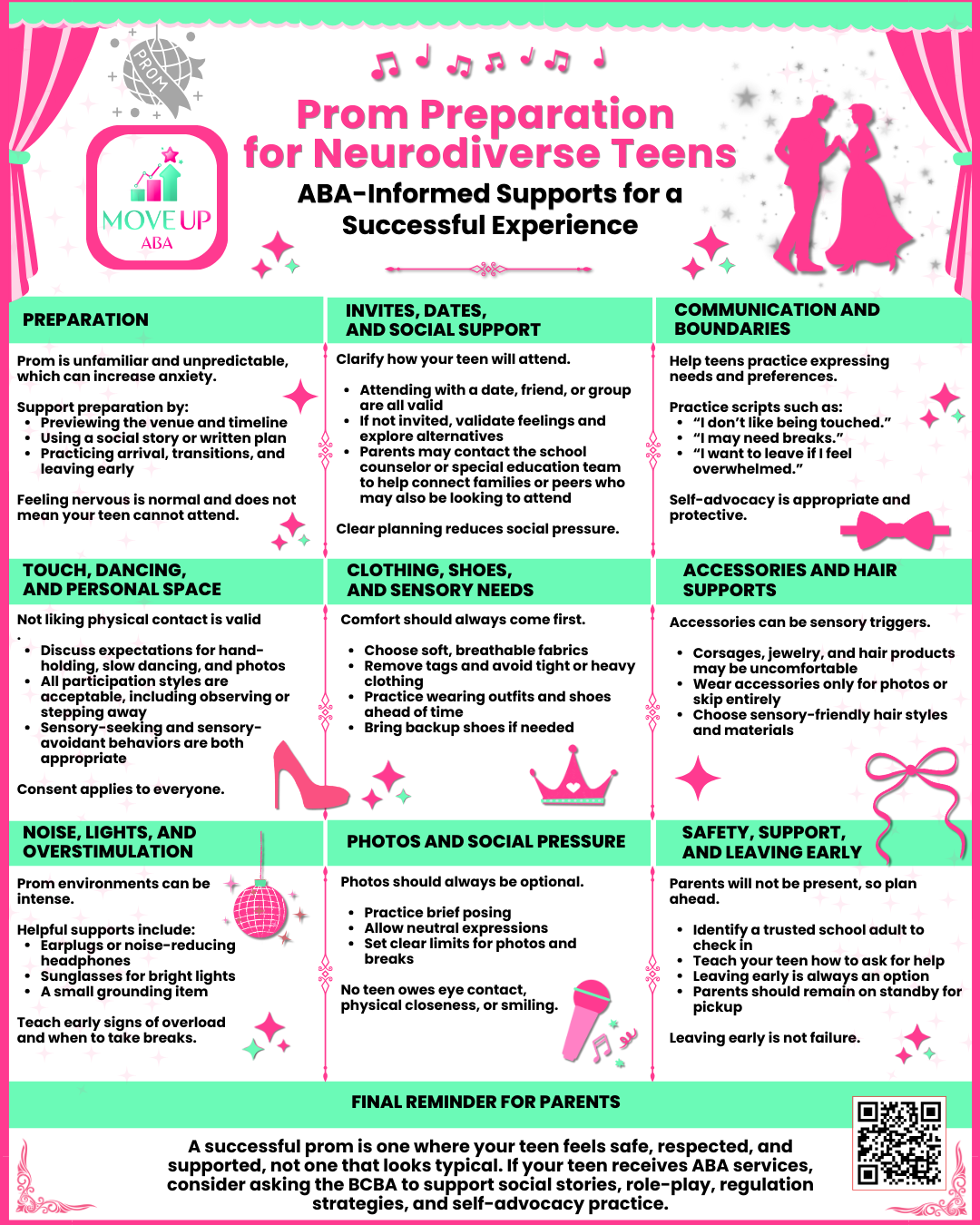
Successful prom preparation for a neurodiverse teen isn’t about making the night look typical. It’s about previewing what to expect, practicing communication and boundary-setting scripts in advance, planning around sensory needs (clothing, noise, lights, touch), keeping photos and physical contact fully optional, and having a real plan in place for checking in and leaving early if needed.
Start by Making the Unfamiliar Familiar
Prom is disorienting largely because it’s unfamiliar and unpredictable, an unusual schedule, an unfamiliar venue, and a lot of new social expectations all arriving at once. That unpredictability is a big part of what drives pre-prom anxiety, not a lack of readiness or interest.
A few things genuinely help: previewing the venue and general timeline ahead of time, building a simple social story or written plan of what the night will actually look like, and practicing the specific moments that tend to cause the most stress, arriving, transitioning between parts of the evening, and leaving early if needed.
Feeling nervous beforehand doesn’t mean your teen shouldn’t go. It means the night deserves the same kind of preparation as any other big, unfamiliar event.
Clarify How Your Teen Will Actually Attend
There’s more than one valid way to go to prom, and it’s worth settling this early rather than assuming. Going with a date, a friend, or a group are all equally legitimate options. If your teen wasn’t asked and that stings, validate the disappointment directly rather than rushing past it, and consider reaching out to the school counselor or special education team, who can sometimes help connect students and families looking for the same kind of low-pressure group arrangement. Clear planning around this specific question tends to lower the overall social pressure of the night considerably.
Practice Communication and Boundaries in Advance
Self-advocacy at prom isn’t a bonus skill, it’s a protective one, and it works far better when it’s practiced ahead of time rather than improvised under stress. A few specific, short scripts are worth rehearsing together before the night itself: “I don’t like being touched,” “I may need breaks,” and “I want to leave if I feel overwhelmed” are all short enough to actually use in the moment, and having them ready in advance takes the pressure off finding the right words on the spot.
If meltdowns and panic attacks are something your teen experiences, it’s worth reviewing the difference together beforehand too, since recognizing which one is happening changes what kind of support actually helps in the moment.
Touch, Dancing, and Personal Space Are Genuinely Optional
Not wanting physical contact is a valid preference, not a problem to work around. It’s worth having a direct conversation in advance about hand-holding, slow dancing, and photos specifically, and being clear that observing from the side or stepping away entirely are both completely acceptable ways to participate. Sensory-seeking behavior (wanting more physical input) and sensory-avoidant behavior (wanting less) are both appropriate responses, not something to correct in either direction. Consent applies here the same way it applies everywhere else.
Plan Around Clothing and Sensory Needs
Comfort should come before appearance when choosing an outfit, not after. A few things worth doing ahead of time: choosing soft, breathable fabrics over stiff formalwear, removing tags, avoiding anything tight or heavy, and actually practicing wearing the full outfit and shoes at home before the event, not just trying them on briefly in a store. Bringing backup shoes is worth the extra bag space if there’s any doubt about comfort holding up over a full evening.
The same thinking applies to accessories and hair. Corsages, jewelry, and styling products can all be genuine sensory triggers, and it’s completely fine to wear them only for photos, or skip them entirely in favor of sensory-friendly hairstyles and materials that won’t need to be tolerated for hours.
Prepare for Noise, Lights, and Overstimulation
Prom environments are intense almost by design: loud music, flashing or strobing lights, and a large crowd in a relatively enclosed space. Understanding why overstimulation happens in environments like this helps explain reactions that might otherwise seem confusing in the moment. A few tools genuinely help: earplugs or noise-reducing headphones, sunglasses for bright or flashing lights, and a small grounding item that’s easy to keep in a pocket or bag.
Just as important as the tools themselves is knowing the early signs of overload before they escalate, and building in regular sensory breaks rather than waiting until things feel unmanageable to step away.

Photos Should Always Be Optional
Photos are one of the more socially loaded parts of prom, and it’s worth setting real limits in advance rather than navigating pressure in the moment. Practicing brief posing ahead of time helps, as does agreeing that a neutral expression is completely fine. No teen owes eye contact, physical closeness, or a smile to get through a photo, and setting that expectation clearly beforehand makes it much easier to hold the line in the moment if someone pushes back.
Have a Real Safety and Check-In Plan
Parents typically aren’t present at prom, which makes a concrete plan more important than it might be at other events. Before the night, identify a specific trusted adult at the venue, a chaperone or teacher your teen already knows, who can serve as a check-in point. Teach your teen a clear, simple way to ask that adult for help if something feels like too much. Make sure leaving early is understood as an available option from the start, not a last resort, and stay genuinely on standby for pickup rather than assuming the full night is the only acceptable outcome.
Leaving early isn’t a failure. It’s the plan working exactly as intended.
Loop In the People Who Already Know Your Teen
If your teen already receives school-based support, prom is worth folding into that existing plan rather than treating separately. Many of the same school-based strategies already in place for a typical school day, clear expectations, check-in routines, a known adult to go to, translate directly to a school event like prom.
If your teen receives ABA services, it’s also worth asking their BCBA specifically about building social stories, role-play practice, regulation strategies, and self-advocacy scripts into upcoming sessions ahead of the event.
Prom is one of several major milestones that tend to benefit from this same kind of advance planning; graduation is often the next one on the calendar, and a lot of the same preparation principles carry over directly.
What Success Actually Looks Like
A successful prom is one where your teen feels safe, respected, and supported, not one that looks like everyone else’s night. That’s worth remembering when the pressure to make it look a certain way creeps in, whether that pressure comes from outside the family or from within it.
We’re Here to Help You Prepare
Every teen’s prom plan looks a little different, and a plan built around your teen’s specific needs works far better than a generic checklist. At Move Up ABA, our ABA therapy for teenagers is built around exactly this kind of real-world, individualized preparation, not just clinical goals on paper. If you’d like help thinking through prom, or any other big social milestone, reach out to our team and we’re glad to talk it through.
Want the quick, printable version? Download our free Prom Support and Preparation Tips resource sheet for an at-a-glance guide you can keep on hand while you plan.
Frequently Asked Questions
What is a sensory-friendly prom, and how do I find one?
A sensory-friendly prom is a dedicated event built with lower lighting, reduced music volume, quiet spaces, and smaller crowds from the start, rather than a traditional prom with individual accommodations layered on. Communities across the country have started hosting these directly; asking your school counselor or a local autism support network is usually the fastest way to find out what’s available in your area.
Should my teen tell their date or friends about their sensory needs in advance?
It’s often genuinely helpful, though it’s ultimately your teen’s choice. A brief, simple heads-up, like letting a date know they may need a quiet break at some point, tends to prevent misunderstandings and makes the night easier for everyone involved.
Are there free or discounted formalwear programs for teens with disabilities?
In many communities, yes. Some nonprofits and school districts offer free or low-cost formalwear, tickets, or full accommodated prom events specifically for students with disabilities, worth asking about through the school or a local autism support organization.
How do I, or my teen, politely decline a promposal or invitation?
A short, direct, kind response works well: something like “Thank you for asking, but I’m planning to go with friends this year” gives a clear answer without requiring a longer explanation.
How can teachers or chaperones help support a neurodiverse student at prom?
Being briefed in advance on a student’s specific needs, knowing a quiet space is available, and checking in quietly rather than drawing attention all help chaperones provide meaningful support without singling a student out.
SOURCES:
- Move Up ABA, “Prom Support and Preparation Tips” resource sheet: https://moveupaba.com/wp-content/uploads/2026/06/Prom-Support-and-Preparation-Tips-Move-Up-ABA.png
- “‘How to Dance in Ohio’: Autistic teens face a daunting ritual — the prom,” The Washington Post: https://www.washingtonpost.com/entertainment/tv/how-to-dance-in-ohio-autistic-teens-face-a-daunting-ritual–the-prom/2015/10/25/45bcea1c-78ec-11e5-b9c1-f03c48c96ac2_story.html
- “Waterbury nonprofit creates sensory-friendly prom for students with autism,” WFSB, June 2026: https://www.wfsb.com/2026/06/22/waterbury-nonprofit-creates-sensory-friendly-prom-students-with-autism/