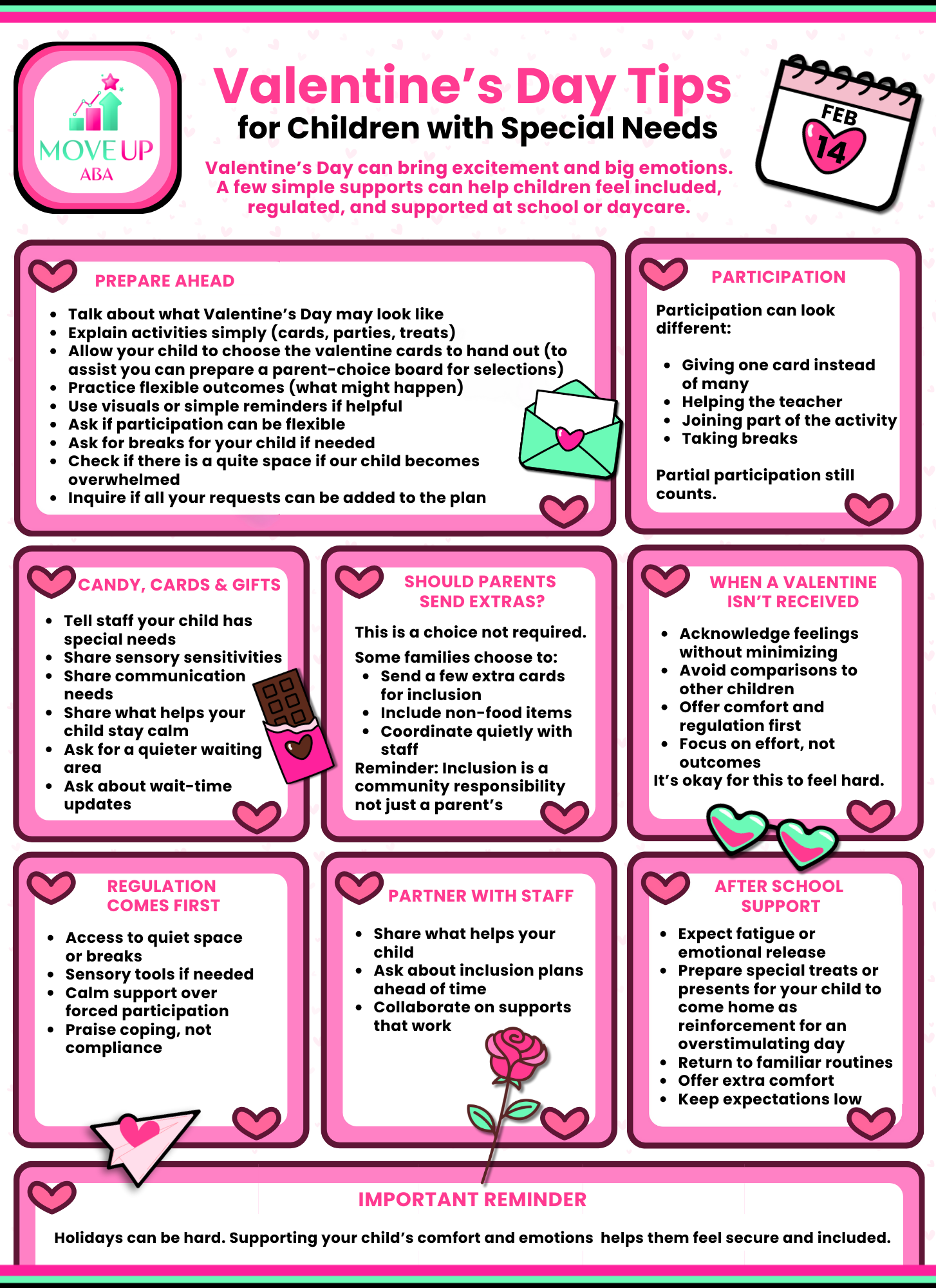
Valentine’s Day sounds simple: cards, candy, a classroom party. For an autistic child, it can mean a full day of unpredictable noise, new textures, and social rules nobody wrote down. Valentine’s Day sensory activities give parents a way to prep for the parts that matter, cards, treats, participation, without forcing a “normal” holiday onto a child who processes the day differently. For families building this kind of preparation into everyday routines, personalized ABA therapy already works on the same regulation and readiness skills this holiday calls for.
Quick answer: Valentine’s Day sensory activities are simple, low-pressure preparations, like a sensory bin filled with heart-shaped textures, a social story that walks through what the day will look like, or a card-sorting game, that help autistic kids get ready for classroom parties and family celebrations without sensory overload. The goal isn’t to make the day picture-perfect. It’s to make it manageable.
Why Valentine’s Day Sensory Activities Matter for Autistic Kids
Hyper- or hypo-reactivity to sound, texture, and touch is part of the diagnostic picture for autism spectrum disorder, and the CDC’s clinical criteria specifically note unusual sensory responses to sounds, textures, and physical contact as a core feature. A classroom Valentine’s party stacks several of those triggers at once: crinkly wrapping, perfume-scented cards, sugar, noise, and a room full of kids moving fast. A large population-based study of autistic children found sensory differences to be widespread, not a rare exception.
That’s exactly where Valentine’s Day sensory activities help. A short prep activity at home does more than fill time. It gives a child a preview of what’s coming, which lowers the odds of the day tipping into overwhelm.
Prepare Before the Big Day Arrives
Preparation is the single biggest lever parents have. A few days of low-key prep beats a same-day surprise every time.
Try a Valentine’s Day social story. A short, simple story that walks through what the day will look like is one of the most researched supports for autistic kids facing a new routine. A systematic review of social stories research found the approach effective for a majority of autistic students preparing for unfamiliar situations, and it works because it turns an abstract event into something concrete and predictable.
A useful prep checklist looks like this:
- Talk through what Valentine’s Day might involve at school or home
- Explain activities in plain terms: cards, a party, maybe treats
- Let your child pick which cards to hand out (a simple choice board works well)
- Practice a few “what might happen” scenarios out loud
- Add visuals or a written reminder if that helps your child
- Ask the teacher directly whether participation can flex
- Confirm there’s a quiet space available if things get overwhelming
- Get any requests written into the day’s plan ahead of time
Build a Valentine’s Day sensory bin. This is one of the easiest sensory activities to set up at home, and it does double duty. It’s calming in the moment, and it previews textures your child might meet at the classroom party: fabric hearts, foam shapes, tissue paper, small candy wrappers. Occupational therapy researchers back this up: a systematic review of play-based sensory interventions found this kind of structured sensory play supports self-regulation in young children with developmental differences. Let your child touch and sort the pieces before the actual event so nothing on the big day is a total surprise.
While you’re prepping, it’s worth covering the logistics too:
- Tell staff in advance about any sensory sensitivities
- Share specific communication needs, not just “autism”
- Note what helps your child stay calm and what escalates things
- Ask for a quieter waiting area if lines or crowds are hard
- Request wait-time updates instead of open-ended waiting
Should parents send extra cards or treats? That’s a choice, not a requirement. Some families send a few extra cards so no classmate is left out, or swap food treats for small non-food items. Either way, inclusion is a shared responsibility between home and school, not something one parent has to solve alone.
Redefining What Participation Looks Like
Autism social skills activities work best when “participation” gets redefined before the day starts. Full participation isn’t the only acceptable outcome, and treating it that way sets kids up to feel like they failed at a party. Special education research has long supported the principle of partial participation, the idea that meaningful engagement doesn’t require doing every step independently. A child can take part in a real, valid way without doing the whole activity start to finish.
Participation on Valentine’s Day can look like:
- Giving out one card instead of twenty-five
- Helping the teacher hand out supplies
- Joining just part of the party, then stepping back
- Taking a break and returning when ready
Partial participation still counts. It’s not a consolation prize.
A real classroom example. One RBT on our team worked with a second grader who found the classroom card exchange overwhelming, mostly the noise and the pressure to make eye contact with each classmate. Instead of skipping the activity, the team built in a modified version: the child handed out cards to four close friends, then moved to a quiet corner with a fidget toy while the rest of the class finished. He still participated. He just did it on terms that worked for his nervous system, and he didn’t melt down before lunch. Building this kind of flexible plan is part of what social communication skills work looks like in practice.
When a valentine isn’t received. Not every child gets a full stack of cards, and for an autistic child, that can land harder than expected. Autistic adolescents report feeling the sting of social exclusion just as intensely as their peers, even when it shows up differently at a neurological level, according to peer rejection research out of Yale. A few things help:
- Acknowledge the feeling without brushing past it
- Skip comparisons to other kids’ piles of cards
- Offer comfort and regulation support before problem-solving
- Focus on the effort your child made, not the outcome
It’s okay for this part of the day to feel hard. It doesn’t mean anything went wrong.
Regulation Comes Before Compliance
Sensory and emotional regulation differences are well documented in autism research, and they don’t switch off because it’s a party. Prioritizing calm over compliance isn’t lowering the bar. It’s meeting a child where their nervous system actually is. Emotion regulation research in autism points to the same theme again and again: kids do better with proactive support and co-regulation than with pressure to simply “hold it together.”
What regulation-first support looks like in practice:
- Easy access to a quiet space or scheduled breaks
- Sensory tools on hand (fidgets, headphones, a weighted item)
- Calm support offered before forced participation
- Praise aimed at coping strategies, not just “good behavior”
A meltdown on Valentine’s Day isn’t a discipline problem. Understanding meltdown triggers ahead of time makes it much easier to catch the early signs before they escalate.
Partner With Teachers and Plan for After School
Teachers can’t read minds, and most want to help but don’t know what “help” looks like for your specific child. Federal special education law already backs this up: inclusive education requirements under IDEA set the expectation that kids with disabilities take part in the full life of the classroom, extracurriculars included, not just academics. A short conversation before Valentine’s Day covers a lot of ground:
- Share what specifically helps your child stay regulated
- Ask what the inclusion plan looks like for the party
- Collaborate on the supports that have worked before
Coverage, scheduling, and the everyday logistics of therapy are questions most families ask us early on, long before a specific holiday comes up.
The party might go fine and your child could still come home wiped out. That’s normal, not a sign that anything failed.
- Expect fatigue or an emotional release after school
- Have a familiar treat or comfort item ready at home
- Return to normal routines as soon as you can
- Offer extra comfort without demanding a play-by-play
- Keep expectations low for the rest of the day
Some kids look completely fine at school and then fall apart the second they’re home and safe. That’s not shutdowns and meltdowns failing to work as strategies. It’s often the opposite: your child held it together all day and finally has a safe place to let go.
The Bottom Line
Holidays built around social expectations are hard for a lot of autistic kids, and Valentine’s Day is one of the bigger ones. A little prep, a flexible definition of participation, and a plan for regulation go a long way toward making the day feel manageable instead of overwhelming. Supporting your child’s comfort isn’t extra credit. It’s what helps them feel secure enough to actually enjoy the day.
Most of what’s above is pulled from our printable Valentine’s Day tip sheet, a one-page visual breakdown that’s easy to save, print, or hand to a teacher before the party. It’s there alongside other printable guides in the resource library.
Every autistic child experiences holidays differently, and Valentine’s Day is just one small window into what daily life can look like. If you’re curious how ABA therapy could build the regulation and social skills behind moments like this one, connect with our team to talk through what that could look like for your child.
Frequently Asked Questions
What are good Valentine’s Day sensory activities for autistic kids?
A sensory bin with heart-shaped textures, a simple social story, and a card-sorting game are all low-pressure Valentine’s Day sensory activities that help kids preview the day before it happens.
How do I make a Valentine’s Day social story for my child?
Keep it short and concrete: describe what will happen, in order, using simple language and pictures if that helps your child follow along.
What if my child doesn’t want to give out Valentine’s Day cards?
That’s fine. Let them choose how many cards to give, or swap the activity for something else entirely, like helping distribute supplies instead.
How can teachers make Valentine’s Day more inclusive for autistic students?
Offer flexible participation options, a quiet space for breaks, and advance notice of the day’s schedule so students know what to expect.
What if my child has a meltdown after a Valentine’s Day party?
Treat it as sensory or emotional overload, not misbehavior. Offer a quiet space, remove demands, and let your child recover at their own pace.
Sources:
- https://www.cdc.gov/autism/hcp/diagnosis/index.html
- https://stacks.cdc.gov/view/cdc/117054/cdc_117054_DS1.pdf
- https://eric.ed.gov/?id=EJ1168996
- https://eric.ed.gov/?id=EJ272747
- https://pmc.ncbi.nlm.nih.gov/articles/PMC3830422/
- https://research.aota.org/ajot/article/78/Supplement_2/7811500270p1/25411/Effects-of-Play-Based-Sensory-Interventions-on
- https://pmc.ncbi.nlm.nih.gov/articles/PMC3272329/
- https://sites.ed.gov/idea/about-idea/