High school graduation is longer, more formal, and more public than anything an autistic student has likely sat through before. Multiple speeches, hundreds of names, a stage in front of the whole community. For an elementary student, the goal is usually getting through the day with the right adult nearby. For a teenager, the goal shifts: it is about the student having a say in how that day goes, which is exactly the kind of planning our ABA therapy team builds into transition-age goals well before senior year.
High school graduation accommodations for autism are less about constant supervision and more about giving an older student the tools, the say, and the sensory supports to get through a long, structured ceremony on their own terms. That shift toward student-led planning is the biggest difference between an elementary graduation plan and a high school one.
Why High School Graduation Accommodations Look Different
Ceremonies at this level are lengthy and highly structured, often running well over an hour with processions, speeches, and a long list of names read aloud. That length alone raises the stakes on planning. But the bigger shift is who is doing the planning. Self-determination and self-advocacy skills are strongly linked to better outcomes for autistic students moving into adulthood, and a graduation ceremony is one of the last major school events where a student can practice speaking up for what they need before that support structure changes.
The Individuals with Disabilities Education Act requires that a student’s IEP address transition services starting no later than age 16, built around the student’s own strengths, preferences, and interests. Graduation accommodations for autism at the high school level fit naturally into that same transition-planning conversation, rather than sitting off to the side as a one-day accommodation request.
Preparing the Student: Practice, Clothing, and Sensory Regulation
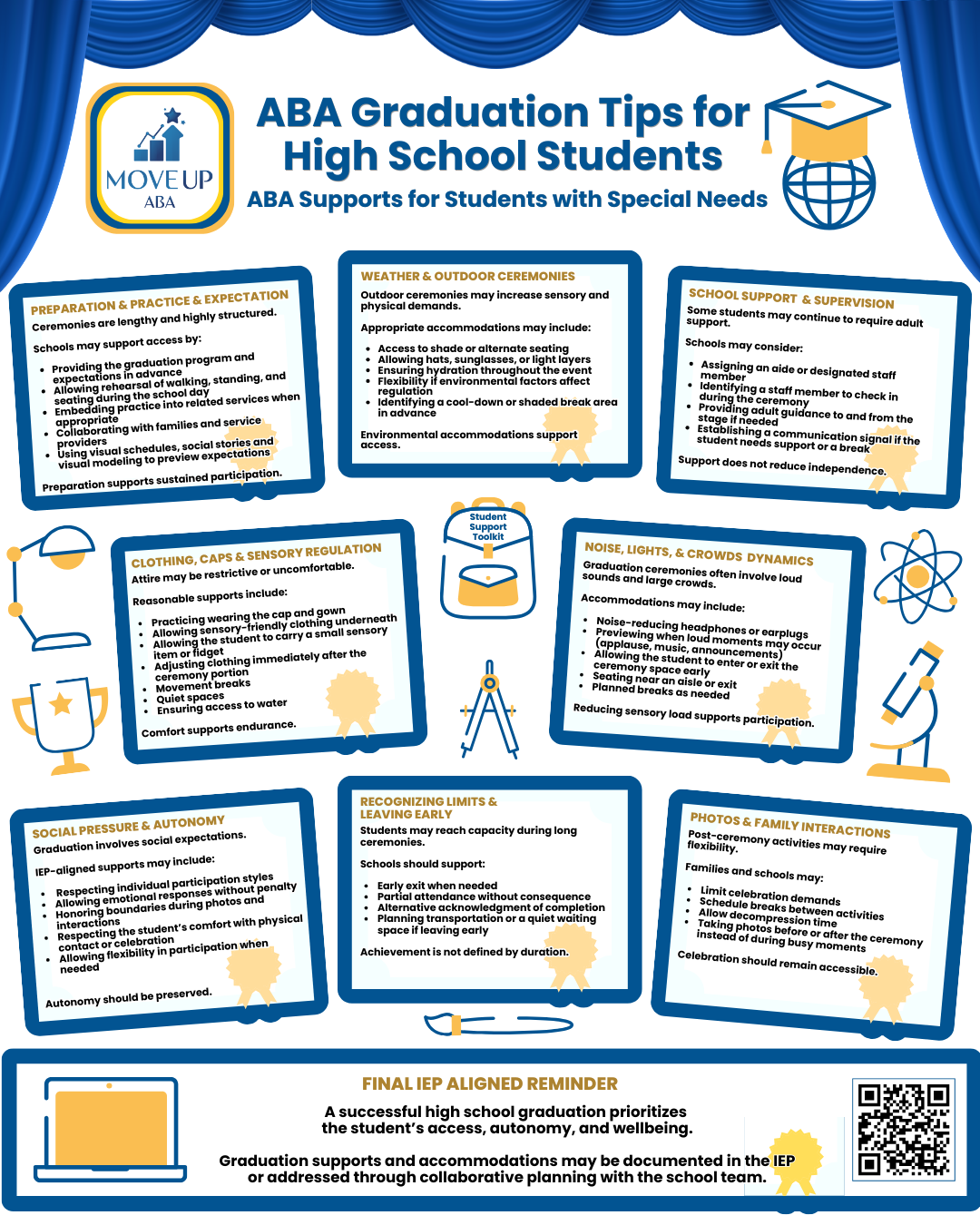
Rehearsal still matters at this age, but it looks different than it does for a younger child. Before the ceremony:
- Send the graduation program and expectations in advance, so the student, not just the family, knows the full sequence
- Allow rehearsal of walking, standing, and seating during the school day, run in a way that respects the student’s own pace
- Embed practice into related services when appropriate, including any ongoing ABA therapy for teens sessions already working on transition skills
- Use visual schedules, social stories, or visual modeling to preview expectations, framed as tools the student can review independently rather than something only a parent walks them through
Preparation at this stage supports sustained participation, but it should be preparation the student is part of building, not just receiving.
Cap-and-gown attire adds another layer. It can be restrictive or uncomfortable for a student with sensory sensitivities, and high school ceremonies tend to run long enough that this becomes a bigger factor than it is in an elementary auditorium. Reasonable supports include practicing wearing the cap and gown ahead of time on the student’s own schedule, allowing sensory-friendly clothing underneath the required attire, permitting a small sensory item or fidget to be carried discreetly, and planning for quiet movement breaks and easy access to water throughout the event. Comfort supports endurance, and for a ceremony this long, endurance is most of the challenge.
Managing Noise, Crowds, and Weather
Graduation ceremonies at the high school level often involve louder sound systems, larger crowds, and more unpredictable moments, cheering, air horns, applause that goes on far longer than at an elementary event. Sensory features, including sound and touch sensitivities, are reported in roughly three in four autistic people, which makes this one of the most common accommodation needs at any large school event, elementary or high school.
Accommodations that help include noise-reducing headphones or earplugs, previewing when loud moments are likely to occur (applause, music cues, or the moment a student’s own name is called), allowing the student to enter or exit the ceremony space as needed rather than requiring them to stay seated the entire time, seating near an aisle or exit, and planned breaks built into the schedule as needed. Reducing sensory load supports participation, and giving a student control over when they step out, rather than an adult deciding for them, is often the accommodation that matters most at this age.
Outdoor ceremonies add the same demands over a longer stretch of time. Shade, hats or sunglasses, scheduled hydration, and a clear cool-down space all help, especially if weather intensifies dysregulation partway through a two-hour event.
Social Pressure, Autonomy, and Recognizing Limits
Graduation involves real social pressure, walking in front of classmates, being watched by extended family, performing a version of “fine” for an audience. Many autistic teens manage this kind of pressure through camouflaging or masking their natural responses, a pattern linked to real exhaustion and stress even when the day looks like it’s going smoothly from the outside.
IEP-aligned supports at this stage may include respecting individual participation styles rather than pushing for a uniform “typical” presentation, allowing emotional responses without penalty, honoring boundaries during photos and physical interactions including hugs, respecting the student’s own comfort with physical contact or celebration, and allowing flexibility in participation when needed. Autonomy should be preserved here, not traded away for a smoother-looking photo.
That same autonomy applies to knowing when to stop. Students may reach their capacity during a long ceremony, and at the high school level, that decision should sit with the student wherever possible. Schools can support this with an early exit when needed, partial attendance without consequence, an alternative way to acknowledge completion, and transportation or a quiet waiting space planned in advance. Achievement is not defined by how long a student sits in a chair.
School Support, a Real-World Example, and the Final Reminder
Some students will still want an aide, a staff check-in, or a clear signal if help is needed. That is a reasonable accommodation at any age. The difference at the high school level is framing: support does not reduce independence, and the student’s own preference for how much help they want should shape the plan.
One student we worked with had strong opinions about her graduation from the start: she wanted to walk the stage, but she did not want anyone hugging her afterward, and she wanted her own noise-reducing headphones on until right before her name was called. Her team built the plan around those preferences instead of a generic accommodation checklist. She walked, she got her diploma, and she left the ceremony on her own terms, not someone else’s idea of what a proud moment should look like.
Post-ceremony celebrations need the same flexibility as the ceremony itself: limiting celebration demands, scheduling breaks, allowing decompression time, and taking photos before or after the busiest moments instead of during them. A successful high school graduation prioritizes the student’s access, autonomy, and wellbeing, documented directly in the IEP or worked out with the school team as part of the same transition planning already shaping the student’s post-graduation goals.
Want Every Step in One Place You Can Hand to the School?
- 📄 Download the free High School Graduation Accommodations Guide, a one-page cheat sheet built around student autonomy, to print or share with the school team.
- 🔗 Explore more free autism resources from Move Up ABA.
A smoother senior year is easier to plan with a team behind you. Move Up ABA’s BCBAs can build transition and graduation goals right into your teen’s ongoing ABA therapy plan. We provide in-home ABA therapy across Maryland and Virginia. Loop in our team to get started.
FAQs
What accommodations help autistic students at high school graduation ceremonies? Common accommodations include noise-reducing headphones, flexible entry and exit, planned breaks, sensory-friendly clothing options, and letting the student set the pace for how much support they want.
Can a high school student decide their own graduation accommodations? Yes, and it’s encouraged. Self-advocacy at this age is linked to better outcomes, so students should help shape their own plan rather than have one handed to them.
How is a high school graduation plan different from an elementary one? It shifts from adult-led supervision toward student-led choices, and it often ties into the transition services already required in a teen’s IEP.
What if my teen wants to skip photos or physical contact after the ceremony? That preference should be honored. Respecting boundaries around touch and photos is part of an autonomy-focused accommodation plan, not an extra request.
Sources: