The grill is on. The neighbors are out. Somewhere a few blocks over, someone is testing a mortar shell at 4pm for no reason at all.
Memorial Day weekend compresses almost every hard thing into 72 hours: broken routines, crowds, unfamiliar food, heat, open water, and sudden noise. Autism and fireworks are the pairing most parents brace for, but the weekend also stacks autism sensory overload, autism elopement risk, and water exposure into the same 72 hours. None of that is a discipline problem. It is a sensory and predictability problem, and it responds to the same planning logic that in-home and school-based ABA therapy uses year round.
Autism and fireworks are a difficult pairing because fireworks produce sudden, high-intensity impulse sound with no warning, and many autistic children process that input more intensely than their peers. Autism and loud noises are only one piece of it, though. The most effective Memorial Day supports are proactive, not reactive: preview the day with pictures or video, use a visual schedule, pack noise protection, identify a quiet space and an exit before you arrive, assign one adult to supervision, and treat short participation as a full success. Autism elopement and water safety need their own explicit plan, because those risks are the highest-stakes part of the weekend.
Why the Holiday Is Hard, and Autism and Fireworks Are Only Part of It
Parades, cookouts, pool parties, and late-night displays all land in the same weekend. That means several demands stacking at once:
- Routine and predictability get disrupted
- Crowds bring unfamiliar people and long waits
- Transitions arrive unannounced, often mid-activity
- Loud noises, flashing lights, and vibration hit without warning
- Heat, smells, and food changes add load, and the American Academy of Pediatrics notes that young children often cannot recognize the early signs of heat-related illness
- Preferred foods may not be available
These behaviors are predictable responses to changed conditions. They are not intentional misbehavior. Knowing what sensory overload looks like in your specific child is the first move, because the signs usually show up well before a full escalation.
Prepare Ahead: Stopping Autism Sensory Overload Before It Starts
Most autism sensory overload at holiday events is preventable by reducing demands before they occur rather than managing them in the moment.
- Preview the plan with photos, short videos, or plain explanations of what will happen
- Build a visual schedule for the day: parade, break, party, home
- Pre-teach expectations, safety rules, and how to request a break
- Identify a quiet space and an exit option at every location before you commit to going
- Pack preferred items, sensory tools, sun protection, and familiar snacks
- Pack hearing protection and put it on early. The National Institute on Deafness and Other Communication Disorders explains that a single burst of intense impulse sound can cause immediate damage, and the CDC treats protecting children’s hearing at loud events as a standing recommendation for every child, not only sound-sensitive ones
- Plan hydration, cooling breaks, and rest into outdoor events on purpose
Scheduled sensory breaks work better than breaks offered only after distress appears. The break is a support, not a reward for holding it together.
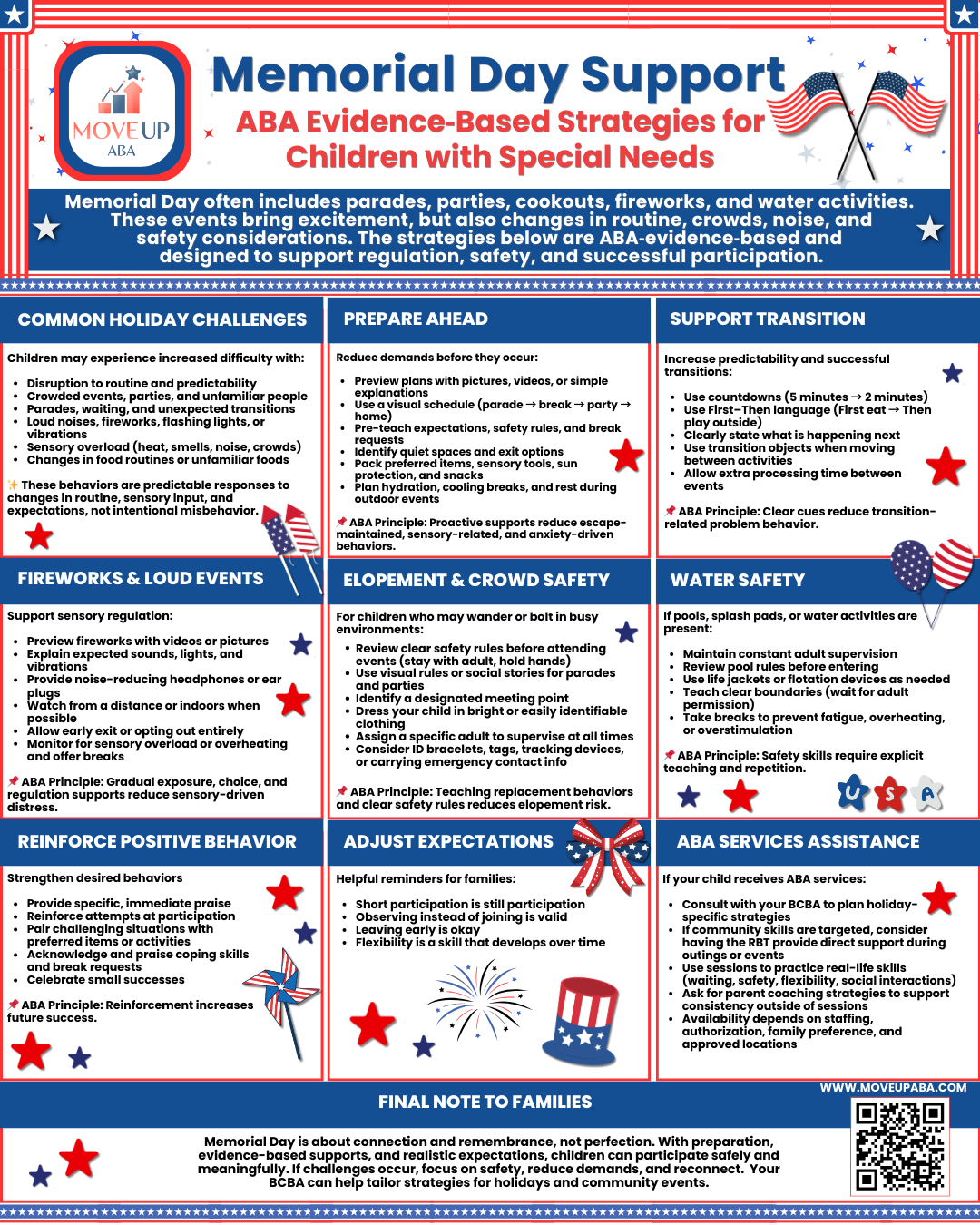
We built the strategies in this article into a single printable sheet covering holiday challenges, preparation, transitions, fireworks, elopement, water safety, reinforcement, and realistic expectations. Download the Memorial Day support sheet and keep it on your phone or stick it on the fridge before the weekend. More printable guides for holidays, transitions, and community outings live on our resources page.
Autism and Loud Noises: A Realistic Fireworks Plan
Autism and loud noises deserve their own plan, because the numbers are genuinely extreme. A World Health Organization review of noise exposure limits for children in recreational settings recommends children not be exposed above 120 decibels of peak sound pressure, compared with 140 for adults. Purdue University audiology faculty note that fireworks displays typically range from roughly 120 to 170 decibels, while ordinary conversation sits near 60. The American Academy of Pediatrics recommends watching professional displays from at least 500 feet away and skipping consumer fireworks entirely around children.
That is a hearing issue for every child at the display, and a regulation issue on top of it for autistic children.
What helps:
- Preview fireworks with videos or pictures at low volume in the days before
- Explain the expected sounds, lights, and vibration in advance
- Provide noise-reducing headphones or ear plugs, and let your child put them on before the first shell
- Watch from a distance, from the car, or from indoors
- Allow an early exit, or opting out entirely, without negotiation
- Watch for overheating and sensory fatigue, and offer breaks before they are requested
Covering ears, crying, or asking to leave is information. Treat it as a signal to reduce exposure, not a behavior to work through.
Autism Elopement, Crowd Safety, and Water Safety: The Non-Negotiables
Autism elopement risk rises sharply in exactly the conditions this weekend creates: dense crowds, distracted adults, open perimeters, and water nearby. Research led by Connie Anderson through the Interactive Autism Network at the Kennedy Krieger Institute, published in Pediatrics in 2012, surveyed more than 1,200 families and found that nearly half of children with autism had attempted to elope after age four. Among children who went missing, families reported close calls with traffic for 65 percent and close calls with drowning for 24 percent. A later nationally representative sample published in PLOS ONE found similar patterns across children with developmental disabilities.
At parades and cookouts:
- Review clear safety rules before entering: stay with an adult, hold hands, ask before moving
- Use visual rules or a social story specific to the event
- Pick a designated meeting point and say it out loud on arrival
- Dress your child in bright, easily identifiable clothing
- Assign one specific adult to supervision at all times, with no rotation confusion
- Consider ID bracelets, tags, tracking devices, or emergency contact info
Around water, the bar is higher. The CDC reports that drowning is the leading cause of death for children ages 1 to 4, and that deaths among people with autism spectrum disorder are nearly 40 times as likely to be caused by drowning as deaths in the general population. Maintain constant supervision with one named watcher at a time, review pool rules every single visit, use life jackets as needed even when swimming was not the plan, teach a wait-for-permission boundary, and build in breaks before fatigue sets in.
Equipment is the backstop. The behavioral work is what lasts. Teaching a replacement behavior for wandering and elopement is what makes a safety rule hold across settings, the same way home safety routines only stick through explicit teaching and repetition.
What a Successful Memorial Day With Autism Actually Looks Like
The following is a composite scenario drawn from patterns our clinicians see across Maryland and Virginia families, not a single client case.
A six-year-old autistic child is invited to a neighborhood parade followed by a cookout with a pool. The parents build a four-picture schedule the night before: parade, snack break in the car, cookout, home. They preview parade videos twice. They pack headphones, a preferred fidget, and a familiar lunch.
At the parade, the child watches for eleven minutes from the back of the crowd, then requests a break using a break card. They take it immediately. At the cookout, one parent handles water supervision for the first hour, the other for the second, and the handoff is spoken aloud. The child does not swim, but sits on the steps in a life jacket for twenty minutes. They leave before dark and watch a display on a phone screen at home.
That was a successful holiday. The child participated, stayed safe, and finished the day regulated.
Reinforcement is what makes the next one easier, so name the specific thing that worked: “you asked for a break, nice.” Reinforce attempts rather than completion. Pair hard situations with preferred items. Then reset the metric. Short participation is still participation. Observing instead of joining is valid. Leaving early is a legitimate choice. Flexibility is a skill that develops over time, and it develops through practice, which is exactly what the clinicians on our team work on with families week to week.
How ABA Therapy Prepares Kids for Fireworks, Crowds, and Water
If your child receives ABA services, autism and fireworks season is a planning opportunity rather than a gap.
- Ask your BCBA to build holiday-specific strategies into the current plan
- If community skills are already targeted, ask whether an RBT can provide direct support during an outing
- Use sessions to practice the real skills the weekend demands: waiting, safety rules, flexibility, social interaction
- Request parent coaching so the strategies hold outside of session hours
Availability depends on staffing, authorization, family preference, and approved service locations, so raise it early rather than the week of.
Memorial Day is about connection and remembrance, not a performance of normalcy. With preparation, evidence-based supports, and honest expectations, children can take part safely and meaningfully. If the weekend goes sideways, the priority order is simple: keep everyone safe, drop the demands, reconnect.
Tell us what you are most worried about this holiday weekend, whether it is the fireworks, the pool, or the drive home afterward. Send a note to our Maryland and Virginia team and we will help you shape a plan you can actually run on the day.
Frequently Asked Questions
What should I know about autism and fireworks?
Autism and fireworks are difficult together because fireworks create sudden impulse sound above safe thresholds for children, with no warning to allow adjustment. Preview, hearing protection, distance, and permission to leave early are the core supports.
How do I help my autistic child during fireworks?
Preview the display with video beforehand, provide noise-reducing headphones or ear plugs, and watch from a distance or indoors. Allow an early exit without negotiation.
How far away should a child be from fireworks?
The American Academy of Pediatrics recommends at least 500 feet from a professional display, and the World Health Organization recommends children not be exposed above 120 decibels of peak sound pressure. Watching from indoors or a vehicle is a reasonable alternative.
How do I stop my autistic child from wandering at a parade?
Review safety rules before arriving, assign one specific adult to supervision, set a meeting point, and use bright clothing plus ID or tracking devices. Teaching a replacement behavior through ABA is what makes the rule hold up over time.
Is it okay to leave a Memorial Day party early with an autistic child?
Yes. Leaving early protects regulation and makes the next community outing more likely to succeed, which is the actual long-term goal.
Are noise-cancelling headphones enough for autistic kids at fireworks?
They reduce intensity but do not eliminate impulse sound at close range, so pair them with distance. Some children tolerate ear plugs better than over-ear headphones.
Sources:
- https://www.cdc.gov/drowning/risk-factors/index.html
- https://www.cdc.gov/hearing-loss-children/about/preventing-noise-induced-hearing-loss.html
- https://www.kennedykrieger.org/stories/nearly-half-children-autism-wander-or-bolt-safe-places
- https://journals.plos.org/plosone/article?id=10.1371%2Fjournal.pone.0148337
- https://cdn.who.int/media/docs/default-source/documents/health-topics/deafness-and-hearing-loss/monograph-on-noise-exposure-limit-for-children-in-recreational-settings.pdf
- https://www.nidcd.nih.gov/health/noise-induced-hearing-loss
- https://www.healthychildren.org/English/safety-prevention/at-play/Pages/stay-safe-this-4th-of-july.aspx
- https://www.healthychildren.org/English/safety-prevention/at-home/Pages/Protecting-Children-from-Extreme-Heat-Information-for-Parents.aspx
- https://www.purdue.edu/newsroom/archive/releases/2018/Q2/fireworks-are-fun-for-the-eyes,-dangerous-for-the-ears,-says-purdue-audiology-expert.html