Pink frosting on the cheek. A balloon arch by the door. A room of people about to break into song. For many kids, that scene is the highlight of the year. For an autistic child, it can also be the moment the day starts to fall apart. The good news is that birthdays do not have to be loud, long, or picture-perfect to be meaningful. With the right plan, Birthday Parties and Big Celebrations: ABA-friendly tips can turn a high-stress event into one your child actually enjoys.
Quick Answer: What Are ABA-Friendly Birthday Party Tips?
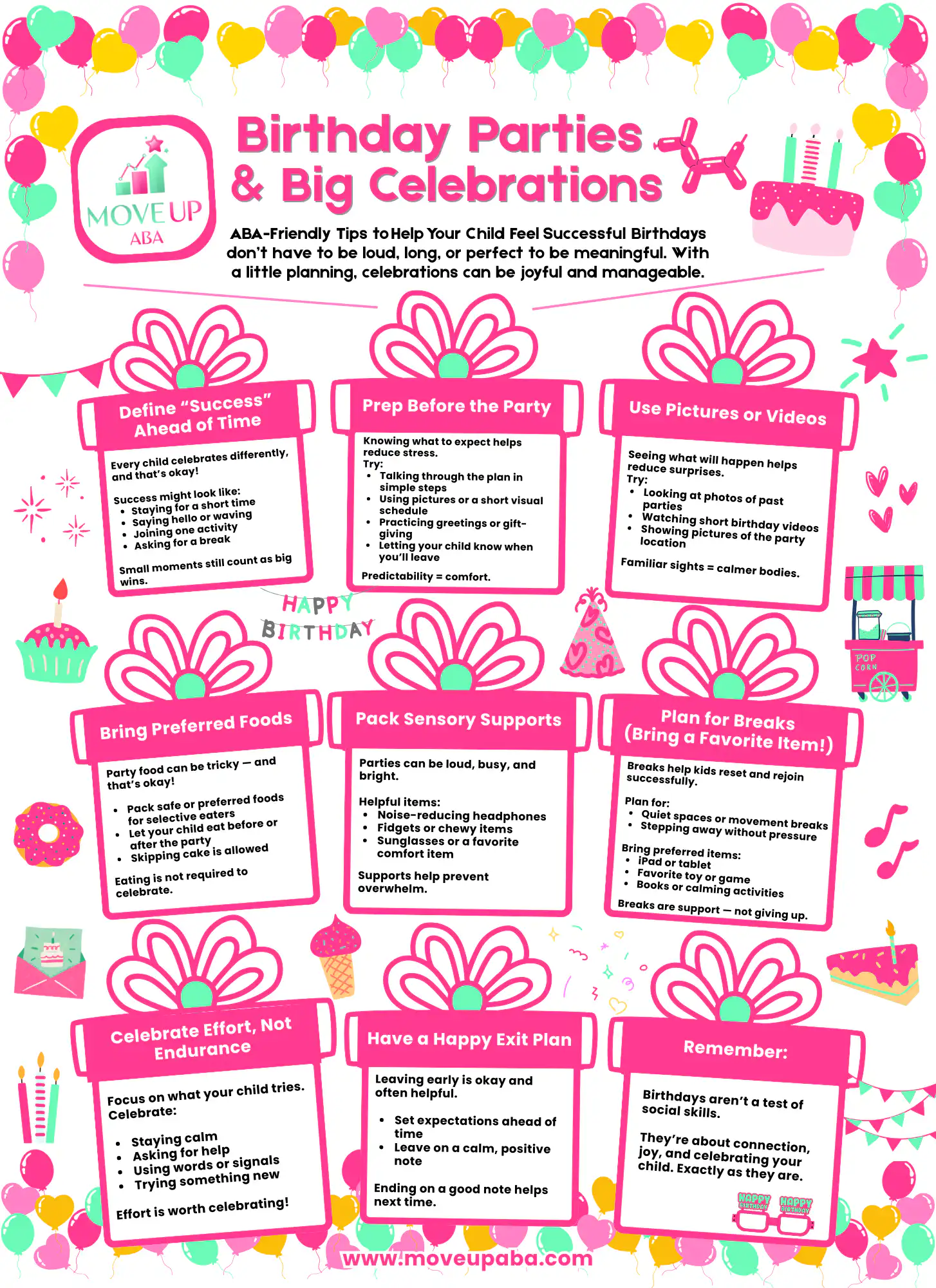
Birthday Parties and Big Celebrations: ABA-friendly tips are practical, evidence-based strategies pulled from Applied Behavior Analysis. They redefine what success looks like, prepare the child in advance, build in sensory supports, plan for breaks, and end on a calm note. The goal is connection and joy, not endurance.
Download the printable Birthday Parties and Big Celebrations: ABA-friendly tips guide here.
Why Celebrations Are Hard for Many Autistic Children
A birthday party is essentially every sensory and social challenge stacked into one room. Research published in the journal Pediatrics found that more than 90% of children on the autism spectrum experience atypical sensory processing, which directly shapes how they cope with parties.
The CDC adds that autistic children often have difficulty with social interactions and changes in routine, the two things every celebration guarantees. That is why Birthday Parties and Big Celebrations: ABA-friendly tips work best when they are planned, not improvised.
Define What Success Looks Like Before You Walk In
Every child celebrates differently. A win for your child might not look like a win on someone else’s social feed, and that is fine.
Success might look like:
- Staying for a short time
- Saying hello or waving
- Joining one activity
- Asking for a break
Small moments still count as big wins. Naming success in advance also gives you something concrete to reinforce in the moment, which is core to ABA.
Prep Before the Party
Knowing what to expect reduces stress. ABA refers to these as antecedent strategies, supports that come before a behavior to make success more likely. The National Clearinghouse on Autism Evidence and Practice confirms antecedent-based interventions, visual supports, and social narratives are established evidence-based practices for autistic children and youth.
Try this in the days before:
- Talk through the plan in simple steps.
- Use pictures or a short visual schedule.
- Practice greetings or gift-giving at home.
- Let your child know exactly when you’ll leave.
Predictability equals comfort.
Use Pictures or Videos to Preview the Day
Seeing what will happen reduces surprises. Visual previews are part of the same evidence-based practice category as social stories, originally developed by Carol Gray and supported by decades of research showing improved behavior and reduced anxiety when children are prepared visually for new experiences.
Try:
- Looking at photos of past parties.
- Watching short birthday videos.
- Showing pictures of the party location, the host, or the cake.
Familiar sights equal calmer bodies.
Bring Preferred Foods
Party food can be tricky, and that is okay. Research on autism and feeding shows that autistic children are about five times more likely to experience food selectivity than non-autistic peers. A birthday party is not the moment to push new textures.
Try:
- Pack safe or preferred foods.
- Let your child eat before or after the party.
- Skipping cake is allowed.
Eating is not required to celebrate.
Pack Sensory Supports
Parties can be loud, busy, and bright. Sensory tools give your child a way to stay regulated when the environment will not cooperate.
Helpful items to pack:
- Noise-reducing headphones
- Fidgets or chewy items
- Sunglasses or a favorite comfort item
Supports help prevent overwhelm before it builds.
Plan for Breaks and Bring a Favorite Item
Breaks help kids reset and rejoin successfully. They are not a sign of failure. The American Academy of Pediatrics emphasizes that predictable routines and structured environments support self-regulation in autistic children, and a scheduled break is part of that structure.
Plan for:
- Quiet spaces or movement breaks
- Stepping away without pressure
Bring preferred items:
- iPad or tablet
- Favorite toy or game
- Books or calming activities
Breaks are support, not giving up.
Celebrate Effort, Not Endurance
ABA is built on reinforcement, which means catching and labeling the moments your child gets it right. At a birthday party, the right thing is often the small thing.
Celebrate:
- Staying calm
- Asking for help
- Using words or signals
- Trying something new
Effort is worth celebrating, even if your child only stays 30 minutes.
Have a Happy Exit Plan
Leaving early is okay, and often the smartest move. A meltdown at the end can rewrite how your child remembers the whole event.
Plan for it:
- Set expectations ahead of time about when and how you’ll leave.
- Leave on a calm, positive note.
Ending on a good note makes the next celebration easier. A case study published in Education and Training in Autism and Developmental Disabilities documented how parent-implemented visual schedules and clear transition supports reduced challenging behavior during community outings, with the effect strongest when the exit was pre-planned.
Remember Why You Are There
Birthdays are not a test of social skills. They are about connection, joy, and celebrating your child exactly as they are. Autism Speaks notes that preparing children in advance with social stories and visual supports significantly improves their participation in celebrations and family gatherings, but participation does not have to look standard to count.
When the Same Triggers Keep Happening
If every birthday party, holiday, or family event ends the same way, that pattern is data. A Board Certified Behavior Analyst (BCBA) can identify the specific trigger, the singing, the gift opening, the food, or the transition home, and build a targeted plan into your child’s existing ABA program.
Move Up ABA’s full library of printable family supports, social stories, and visual schedules lives on the Move Up ABA Resources page.
A printable, one-page version of these Birthday Parties and Big Celebrations: ABA-friendly tips is attached to this post. Save it to your phone, print it for the fridge, or share it with grandparents, party hosts, or anyone celebrating with your child.
Let’s Make the Next Cake One You Both Enjoy
The candles keep coming. Holidays keep landing on the calendar. The question is whether your family meets the next celebration with a plan or without one. If birthdays, holidays, or family gatherings consistently leave your child overwhelmed and you exhausted, that is a conversation worth bringing to Move Up ABA. Reach out to schedule a visit, and our team will build celebration prep directly into your child’s program, complete with the social stories, visual schedules, and reinforcement plan tailored to your family’s actual calendar. Cake should be the hard part. Nothing else has to be.
FAQ
What are Birthday Parties and Big Celebrations: ABA-friendly tips?
They are evidence-based ABA strategies, including defining success in advance, visual preparation, sensory supports, planned breaks, reinforcement, and a calm exit, used to help autistic children participate in celebrations.
Why are birthday parties hard for autistic children?
Parties combine loud noise, crowds, unfamiliar food, schedule changes, and unexpected transitions. Most autistic children experience atypical sensory processing, which makes high-stimulation environments harder to regulate in.
How early should I prepare my child for a party?
Begin one to two weeks ahead with photos, videos, or a social story. Rehearse greetings and key moments in the days right before.
Is it okay to leave a party early?
Yes. Leaving on a calm, positive note protects how your child remembers the day and makes the next celebration easier.
Does my child have to eat cake?
No. Many autistic children experience food selectivity. Packing preferred foods or skipping cake entirely is a valid choice.
Sources
- https://publications.aap.org/pediatrics/article-abstract/142/6/e20174322/76869/Adherence-of-Newborn-Specific-Antibiotic?redirectedFrom=fulltext
- https://www.cdc.gov/autism/signs-symptoms/index.html
- https://carolgraysocialstories.com/social-stories/
- https://publications.aap.org/pediatrics/article/145/1/e20193447/36917/Identification-Evaluation-and-Management-of