Pools are filling. Lakes are warming. The neighborhood backyards across Maryland and Virginia are about to host the kind of casual summer gatherings where one moment of distraction can become a tragedy.
For families of children with autism, this season brings a danger that is documented, statistically severe, and — most importantly — preventable when families know what to do.
Here’s the direct answer: Drowning is the leading cause of death for autistic children who wander, accounting for 71% to 91% of fatal elopement outcomes depending on the year and study (National Autism Association, 2017–2024 data). Children with autism are 160 times more likely to die from drowning than the general pediatric population (Columbia University Mailman School of Public Health, 2017). Approximately 49% of autistic children attempt to elope from a safe environment — nearly four times the rate of their non-autistic siblings (Pediatrics, 2012). The most effective prevention combines four elements: physical barriers (fencing, locks, alarms), early adaptive swim instruction, ABA-based water desensitization and safety teaching, and an elopement response plan shared with neighbors and first responders. If your family is navigating wandering or elopement behaviors and needs structured behavioral support, Move Up ABA’s in-home programs include safety-focused behavioral teaching as part of individualized plans for Maryland and Virginia families. This guide walks through what the data says, how ABA tools support water safety specifically, and where to find adaptive swim instruction in our service area.
Why Drowning Is the Leading Cause of Death in Autism Wandering
The numbers behind autism water safety are stark — and Maryland and Virginia families with pools, proximity to Chesapeake Bay, river access, or apartment complex swimming areas need to know them.
Key statistics every family of an autistic child should know:
- 49% of autistic children attempt to elope from a safe environment, nearly four times the rate of unaffected siblings (National Autism Association citing 2012 Pediatrics study)
- 160 times more likely — children with autism are 160 times more likely to die from drowning compared to the general pediatric population (Columbia University Mailman School of Public Health, 2017 study)
- 91% of wandering deaths in U.S. autistic children under age 14 in 2024 were caused by drowning, according to National Autism Association tracking data
- An average of 7 children with autism die per month in the U.S. after wandering, primarily from drowning (National Autism Association, 2024)
- More than one-third of autistic children who wander are never or rarely able to communicate their name, address, or phone number when found (NAA / 2012 Pediatrics study)
- 46% of autistic children who drowned were last seen in their home or yard — meaning familiar environments don’t eliminate risk (CDC data cited by NAA)
- Wandering risk peaks around age 5 but persists throughout childhood and adolescence
- Children 5–9 years old show the highest number of fatal outcomes; children under 5 face the highest lethal risk per incident (NAA Mortality & Risk Study, 2017)
The pattern is consistent across multiple data sources spanning 2012 to 2024: when an autistic child wanders, water — open pools, hot tubs, ponds, lakes, rivers, drainage ditches — is the most common fatal destination (National Autism Association — Wandering & Drowning Risk).
Why Are Autistic Children Drawn to Water?
Understanding the attraction is the first step in addressing the risk. Research and clinical experience identify several reasons why water is particularly compelling for many autistic children:
Sensory attraction. Water provides predictable, repetitive sensory input — movement, sound, light reflection, temperature — that can be deeply regulating for the autistic nervous system. The same sensory profile that draws an autistic child to stim with hand movements or repetitive sounds often draws them to water (Varleisha Gibbs, OTD, OTR/L, cited in ScienceDaily, 2014).
Lack of fear response. Many autistic children do not develop or apply typical danger-recognition responses to deep water. A non-autistic toddler instinctively hesitates at the edge of a pool. An autistic child may walk directly in — particularly if water is associated with positive sensory experiences during supervised bath or swim time.
Bolting from overstimulation. Crowds, noise, and unfamiliar environments — common features of summer outdoor gatherings — can overwhelm an autistic child’s sensory regulation. Bolting away from the overwhelming environment, sometimes toward water, becomes an escape behavior.
Inability to communicate distress. Autistic children with limited verbal communication may not call for help when struggling. Drowning is often silent in any child, but is even more so when verbal request for help is not part of the child’s repertoire.
This is why standard “watch them around water” guidance is insufficient for autism. The combination of elopement risk, water attraction, low fear response, and communication differences requires a substantially different prevention plan.
The Four-Layer Water Safety Plan for Autism
Effective autism drowning prevention is layered. No single intervention is sufficient. National safety organizations including the National Autism Association recommend prevention plans built on four reinforcing layers..
Layer 1 — Physical Barriers
Physical barriers are the foundation. Without them, every other layer can be defeated by a single moment of inattention.
For pools (in-ground or above-ground):
- Fencing with self-closing, self-latching gates higher than the child’s reach
- Pool covers when not in use
- Pool alarms that detect entry into water
- Removal of all toys and items of interest from the pool when not supervised — items in the water draw a wandering child
For home and yard:
- Door alarms on every external door
- Window locks beyond the child’s reach
- Deadbolts requiring keys for indoor side (where local code allows for fire safety reasons)
- Fencing around the entire yard, not just the pool area
Important context for Maryland and Virginia families: State pool fencing codes specify minimum heights and gate requirements. Maryland requires barriers around residential pools per state building code; Virginia has similar requirements at the state and local level. Both states’ codes exceed federal minimums in many jurisdictions (National Drowning Prevention Alliance — State Pool Fence Requirements).
Layer 2 — Early Adaptive Swim Instruction
Swimming lessons reduce drowning risk — but children with autism often need adaptive instruction designed for their sensory and communication needs, not standard group lessons.
What adaptive swim instruction looks like:
- Low instructor-to-child ratio (often 1:1 for children with significant support needs)
- Slower pacing with sensory acclimation built in
- Visual supports and pictorial instruction
- Predictable session structure that does not change between visits
- Instructor trained in autism-specific accommodations
Where to find adaptive swim instruction in Maryland and Virginia:
- Maryland: Adaptive swim programs are offered through several local YMCAs (the Y of Central Maryland, Y in Central Maryland Adaptive Aquatics program), Special Olympics Maryland, the Kennedy Krieger Institute (Baltimore), and many independent providers across the state.
- Virginia: Adaptive swim instruction is available through multiple YMCA branches, including the Fairfax YMCA and Arlington YMCA adaptive programs, plus specialized providers including SwimRVA, Fairfax County Park Authority adaptive swim programs, and inclusive private instructors.
The National Autism Association maintains a resource for locating special needs swimming lessons, and recommends families search “Special Needs Swimming Lessons” + their city for local options.
Layer 3 — ABA-Based Water Safety Teaching
This is where structured behavioral support fills a gap that physical barriers and swim lessons cannot address alone. ABA-based water safety teaching addresses the behavioral and cognitive dimensions of water safety: recognizing water as a hazard, responding appropriately near water, and developing safe water entry and exit routines.
ABA tools commonly used for water safety:
Social stories. A social story is a short, individualized narrative — often with visual supports — that describes a situation, expected behavior, and the perspectives of others. For water safety, social stories address: “Why I always wait for an adult before going in water,” “What to do if I see water and want to go in,” “Pool rules in our backyard.” Carol Gray developed the Social Stories framework in 1991 and it has decades of research support as an evidence-informed practice for autistic children.
Water desensitization protocols. For children with sensory sensitivity to water — or, conversely, those who lack appropriate caution — graduated exposure protocols can build appropriate responses through small, reinforced steps. This is structured behavioral teaching, not simply spending time in water.
Functional Communication Training (FCT). For children with limited verbal communication, FCT teaches functional ways to request water-related needs — to ask to enter water, to request to leave, to call for help — using whatever communication modality the child uses (verbal, AAC, sign, picture exchange).
Safety signal teaching. Teaching reliable response to “stop,” “wait,” and emergency call/come commands — and reinforcing these responses heavily so they generalize to real-world water situations.
Wandering-specific behavioral support. Many families dealing with elopement benefit from individualized behavioral plans that address the function of the wandering behavior. Wandering is communication — the child is moving toward something or away from something. Identifying the function allows targeted intervention.
Move Up ABA’s school-based ABA programs and in-home services include safety-focused programming when relevant to a child’s individual needs — particularly for families managing elopement behavior.
Layer 4 — Elopement Response Plan
If a wandering incident does occur, the speed and direction of the response matters enormously.
Critical components of an elopement response plan:
- Always search nearby water first. This is the single most important rule from autism safety organizations. Pools, hot tubs, ponds, drainage areas, and any open water within walking distance should be checked before anywhere else.
- Inform neighbors. Specifically, neighbors with pools should be told that your child is autistic, may wander, and may be attracted to water. Many fatal outcomes occur in neighbor pools where the family was unaware.
- First responder identification. Many families register their child with their local police department’s special needs registry or with programs like Project Lifesaver, which provides a tracking device that emergency responders can locate. Maryland and Virginia counties operate Project Lifesaver programs through local sheriff’s offices and police departments.
- Identification on the child. ID bracelets, GPS trackers, and shoe ID tags all help bystanders or first responders identify and reach the child’s family quickly.
- Written safety plan. Have a documented plan that includes home address, child’s autism diagnosis, communication abilities, sensory sensitivities, and known attractions. Share this with schools, caregivers, and emergency responders.
The National Autism Association’s “Big Red Safety Box” and “Be REDy” resources provide free, downloadable safety planning materials specifically designed for families of autistic children.
Move Up ABA and Water Safety: How Behavioral Support Fits In
For families in Maryland and Virginia, ABA therapy can play a substantial role in addressing the behavioral dimensions of water safety. This is not a substitute for swim instruction or physical barriers — it is a complement that addresses the cognitive and behavioral components those layers don’t cover.
In an individualized ABA program, a Board Certified Behavior Analyst (BCBA) can:
- Develop social stories specific to the child’s water environments
- Build safety teaching into existing behavioral plans
- Train parents to implement water safety teaching at home and in community settings
- Coordinate with adaptive swim instructors to align behavioral teaching across settings
- Address underlying elopement behavior through functional behavior assessment and individualized intervention
- Help families navigate the integration of water safety with broader autism support plans
Move Up ABA’s home-based ABA therapy for families across Maryland and Virginia includes individualized programming that can specifically address safety-related behavioral goals when those goals are part of the child’s clinical plan.
For families dealing with active elopement or significant wandering risk, this kind of in-home behavioral support is most effective when started before summer pool season — giving time for skill building and generalization in lower-stakes contexts first.
Maryland and Virginia: Local Resources for Autism Water Safety
Maryland and Virginia families have access to specific local programs and resources worth knowing about:
Maryland resources:
- The Y in Central Maryland — Adaptive Aquatics program
- Kennedy Krieger Institute (Baltimore) — assessment and intervention services
- Special Olympics Maryland — adaptive aquatics
- Project Lifesaver Maryland — tracking devices through county sheriff offices
- Autism Society of Maryland — community resources and family support
Virginia / Northern Virginia resources:
- Fairfax YMCA and Arlington YMCA — adaptive swim programs
- Fairfax County Park Authority — adaptive aquatics
- SwimRVA — adaptive swim programming
- Project Lifesaver Virginia — operated through participating county sheriff and police departments
- POAC-NoVA (Parents of Autistic Children of Northern Virginia) — local advocacy and community support
Both states’ Medicaid programs cover ABA therapy services that can incorporate safety-related behavioral goals as part of individualized programming.
A Practical Summer Safety Checklist for Maryland and Virginia Families
Before summer water season begins in earnest, families of autistic children can take these specific actions:
✅ Inspect physical barriers. Confirm pool fencing is intact, self-closing gates work, alarms are functional. Replace batteries on door alarms and window sensors.
✅ Enroll in adaptive swim lessons. If your child is not already enrolled in swim instruction, contact a local adaptive program. Start before the summer rush — programs fill quickly in June.
✅ Develop a written elopement response plan. Include home address, child’s autism diagnosis, sensory profile, communication ability, and known water attractions. Share with schools and caregivers.
✅ Talk to neighbors. Specifically alert neighbors with pools that your child is autistic and may wander toward water.
✅ Register with Project Lifesaver (or similar program) through your county sheriff or police department if your child has significant elopement risk.
✅ Use identification. ID bracelets, shoe tags, or GPS trackers help ensure quick identification if your child is found by others.
✅ Build water safety into ABA programming. If your child receives ABA therapy, discuss water safety teaching with the BCBA before summer.
✅ Practice emergency commands. “Stop,” “wait,” and emergency call/come commands should be heavily reinforced and rehearsed in low-stakes contexts.
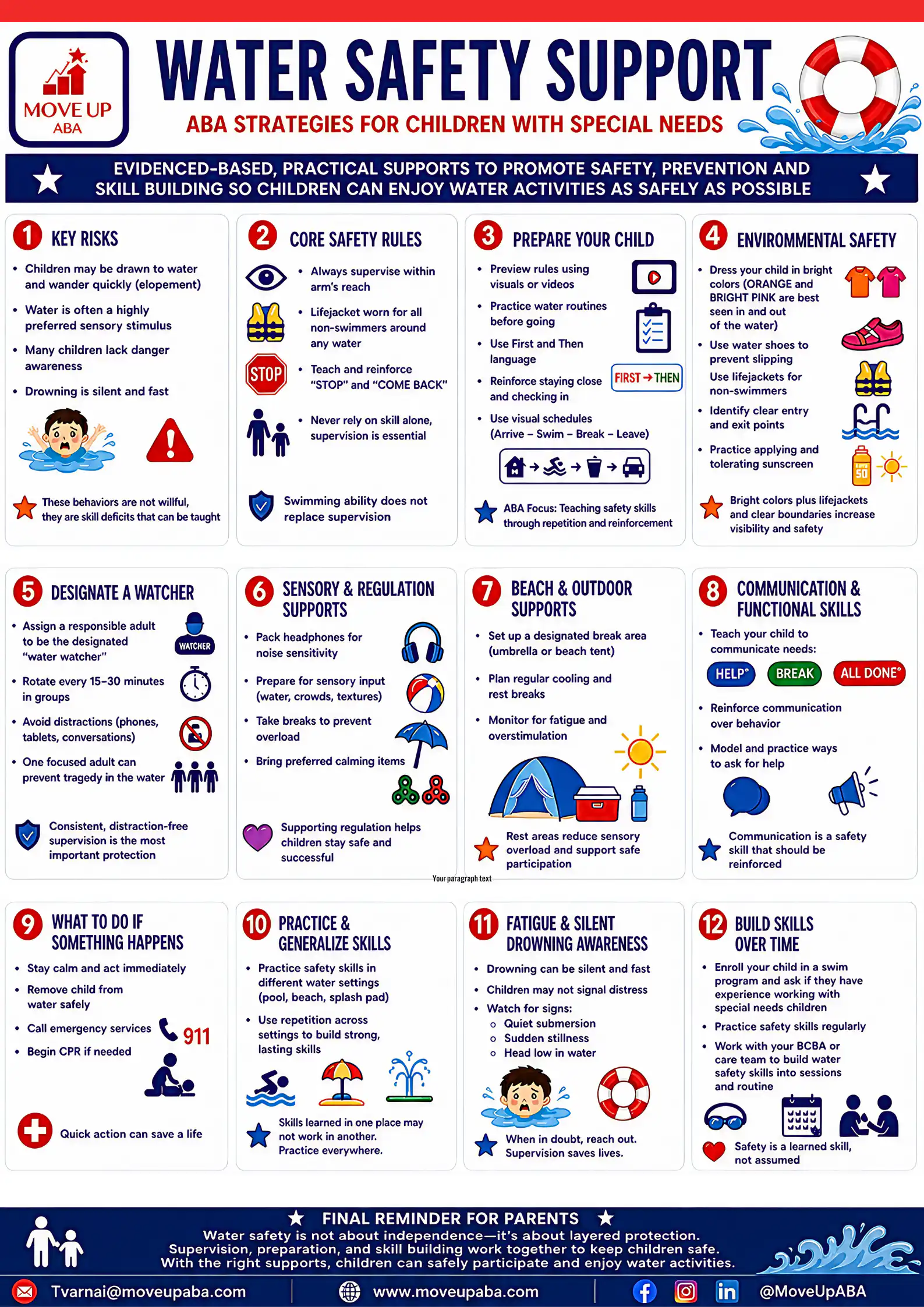
Want every step in one place you can pack for the pool?
- 📄 Download the free Water Safety Support guide — a one-page cheat sheet built around sensory-friendly water safety, to print or share with lifeguards, camp staff, or swim instructors.
- 🔗 Explore more free autism resources from Move Up ABA.
Conclusion: The Numbers Are Severe — and the Prevention Tools Work
The statistics around autism and drowning are sobering. But they are also actionable. The same data that documents the elevated risk also points to the layered prevention strategies that reduce it: physical barriers, adaptive swim instruction, ABA-based behavioral teaching, and well-rehearsed elopement response plans.
The combination matters. Pool fencing without swim lessons leaves the door open to outdoor wandering scenarios. Swim lessons without behavioral teaching leave gaps in real-world judgment and self-regulation. Behavioral teaching without physical barriers fails in the moment of inattention every family experiences. Every layer reinforces the others.
For families across Maryland and Virginia, this combination of resources is genuinely accessible — adaptive swim programs, Project Lifesaver tracking, ABA therapy covered by Medicaid and private insurance, and free safety planning materials from autism safety organizations. The hardest part is starting.
If you’re working through wandering or elopement behaviors with a child on the autism spectrum, get in touch with our Move Up BCBAs to find out if individualized ABA therapy is right for your child — most families across Maryland and Virginia begin services within 2–4 weeks of contact.
Your child’s safety this summer starts with what you do before the temperatures rise. Connect with the Move Up ABA team today — we’ll help you build the behavioral support layer of your family’s water safety plan.
FREQUENTLY ASKED QUESTIONS
Q: How much more likely are autistic children to drown compared to other children?
A: According to a 2017 study from Columbia University’s Mailman School of Public Health, children with autism are 160 times more likely to die from drowning than the general pediatric population. The National Autism Association reports that drowning accounts for 71% to 91% of fatal outcomes following elopement in autistic children, depending on the year. An average of seven autistic children die per month in the U.S. from wandering-related drowning.
Q: At what age is wandering risk highest for autistic children?
A: Wandering behavior peaks around age 5, but persists throughout childhood and adolescence. Children aged 5–9 show the highest absolute number of fatal outcomes from wandering, while children under 5 face the highest lethal risk per incident (approximately 60% of cases involving children under 5 end in death). However, drowning risk persists into the teen years and beyond.
Q: Can ABA therapy specifically help with water safety for autistic children?
A: Yes. ABA-based interventions for water safety include social stories about water environments, water desensitization protocols, functional communication training to teach the child to request help or signal distress, and reliable response training for safety commands like “stop” and “wait.” A BCBA can build water safety teaching into an individualized ABA program when relevant to the child’s safety needs.
Q: When should autistic children start swim lessons?
A: As early as possible. The National Autism Association and the American Academy of Pediatrics both recommend early enrollment in adaptive swim lessons. Swimming ability reduces — but does not eliminate — drowning risk. Even children who can swim need the full four-layer prevention plan: barriers, swim skills, behavioral teaching, and elopement response.
Sources:
https://www.autismparentingmagazine.com/connection-autism-water/
https://www.thetransmitter.org/spectrum/children-autism-muted-fear-response/
https://www.thetransmitter.org/spectrum/children-autism-muted-fear-response/
https://nationalautismassociation.org/resources/autism-safety-facts/
https://nationalautismassociation.org/watersafety/
https://educationonline.ku.edu/community/communication-difficulties-in-autism-spectrum-disorder