Twenty kids shouting at once. A lunch bag splitting open on the sidewalk. A bus engine idling six feet away. The day has not technically started yet.
Field trips for autistic students are school outings planned with sensory, communication, and safety supports arranged ahead of time, rather than improvised once a child is already overwhelmed. The real work happens before anyone boards the bus: previewing the destination, packing a regulation kit, rehearsing the safety rules, and confirming accommodations in writing. Preparation converts an unpredictable day into a familiar sequence, which is the same logic that drives good ABA therapy in any setting.
Why Field Trips for Autistic Students Are Hard Before They Start
Novelty is the point of a field trip. It is also the problem.
The CDC includes hyper- or hyporeactivity to sensory input among the diagnostic features of autism, listing adverse responses to specific sounds or textures as examples. A museum lobby stacks several of those at once. Add an unfamiliar schedule and the load climbs fast, which is why catching the early signs of sensory overload matters more on trip day than on an ordinary Tuesday.
Predictability does real work here. A meta-analysis of 31 studies led by Francisca van Steensel at the University of Amsterdam found that 39.6% of young people with autism met criteria for at least one anxiety disorder, with specific phobia the most common. Unknowns are not neutral. They cost something.
Preview the Trip a Week Early
A social story field trip walkthrough is the cheapest support available. Social narratives and visual supports both appear on the evidence-based practice list compiled by the National Clearinghouse on Autism Evidence and Practice at the University of North Carolina.
Laura Schreibman and colleagues at UC San Diego tested a related method called video priming, showing children short point-of-view videos of a difficult transition before it happened. Disruptive behavior dropped, and the improvement carried over to transitions the children had never been primed for.
Build the preview around the real location:
- Photos or short video of the actual venue, not a generic stand-in
- The venue’s virtual tour, if one exists
- The day laid out in order: bus, arrival, activity, lunch, bus home
- Plain “First, then” language for each step
- A rehearsal of the transitions, since that is where days usually wobble
Low-stakes practice runs build the same muscle. A grocery store on a Tuesday afternoon is preparation for an aquarium on a Friday morning.
The Field Trip Checklist: Regulation, Occupation, Weather
A field trip checklist for autistic students covers three separate jobs, and packing for only one of them is where most bags go wrong.
Regulation. Noise-canceling headphones or ear protection, a comfort item or small preferred object, preferred snacks and water, a change of clothes, and any required medication coordinated with school staff in advance.
Occupation. Travel time is dead time, and dead time invites escalation. Pack books, quiet games, a tablet if that fits your child’s plan, fidgets, familiar items, and flash cards on a keyring showing the destination. Planned sensory breaks built into the schedule work better than reactive ones after an escalation has already begun.
Weather. Layers, rain gear, sunscreen, a hat. Nothing brand new. NHS England’s sensory-friendly guidance flags touch and texture as an area where hyper- and hyposensitivity change what a person can tolerate. Stiff seams and unbroken-in shoes become three hours of low-grade distress on an exhibit floor.
Autism Elopement and the Rules Worth Rehearsing
Autism elopement means wandering or bolting from a safe setting, and it deserves explicit planning on trip days. Research led by Connie Anderson through the Interactive Autism Network at the Kennedy Krieger Institute in Maryland, published in Pediatrics, found that 49% of parents reported their autistic child had attempted to elope after age 4. Of those children, 53% went missing long enough to cause serious concern. A later analysis of CDC survey data in PLOS ONE found elevated elopement rates in a nationally representative sample of children with developmental disabilities.
Rehearse the rules at home, not on the bus:
- Stay with your group at all times
- Ask an adult when you need help
- Do not walk away from the group
- Learn who the safe adults are, by name and by face
If a tracking device is part of your family’s plan, charge it the night before, attach it securely to clothing, a shoe, or a backpack, test the accuracy at home, and give the school access instructions.
What to Ask the School and the Venue
This is not a favor you are requesting. IDEA regulations on nonacademic settings require public agencies to provide the supplementary aids and services a student’s IEP team determines are necessary for participation in nonacademic and extracurricular activities. Field trips sit squarely inside that category, which is why trip planning belongs in IEP discussions rather than in the parking lot on the morning of.
Ask the venue whether the location is accessible, whether quiet or sensory-friendly spaces exist, whether waiting in line can be reduced, and whether an alternative entry point is available. Get the answers in writing.
Then give the school what it needs: known triggers, early warning signs, calming strategies that actually work, your phone number, elopement risk, and any relevant medical or behavioral needs. Teams delivering school-based ABA often help families draft this handoff so nothing critical lives only in a parent’s memory. Ask who the chaperone or aide will be, and request a photo so that person arrives familiar instead of new.
Bathroom readiness belongs in the same conversation. Decide whether your child can use a public restroom independently, review the steps beforehand, discuss privacy and staying in the stall, and tell staff plainly if support is needed.
One Aquarium Trip, Start to Finish
In our sessions with a Maryland second-grader, the sticking point was never the fish. It was the twenty-minute line at the entrance.
We built a five-photo sequence: entrance, line, ticket counter, first tank, bus home. He reviewed it twice a day for a week. His team packed headphones and a laminated copy of the sequence on a keyring. The chaperone received exactly one instruction: if he taps the keyring, step out of line for two minutes. He tapped it once. He finished the trip.
Nothing in that plan was exotic. Preview, a portable visual, and a pre-agreed exit.
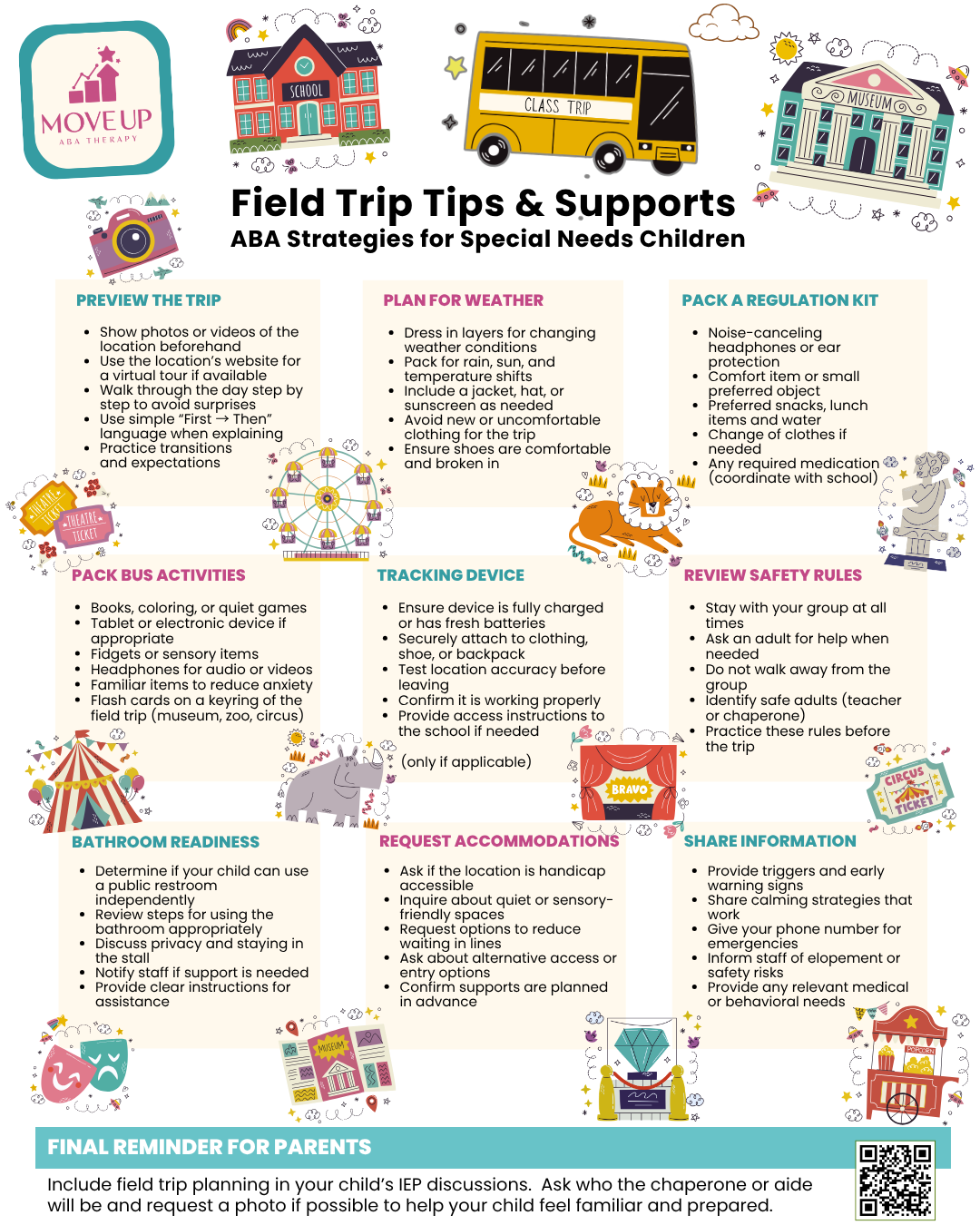
Everything above is condensed into a one-page visual guide covering trip preview, weather, the regulation kit, bus activities, tracking devices, safety rules, bathroom readiness, accommodation requests, and what to share with staff. Download the Field Trip Guide 📄, print it, and keep it on the fridge through the school year. More parent tools sit alongside it in our resources library 🔗.
Field trips for autistic students are not a test your child passes or fails. They are a sequence of small, predictable steps you can put in place a week ahead. If a trip is already on the calendar and you want a second set of eyes on the plan, send us a message and let’s map out what would make that day work.
FAQs
How do I prepare my autistic child for a field trip?
Preview the location with photos or a virtual tour, rehearse the day in order using “First, then” language, and pack a regulation kit with headphones, snacks, and a comfort item. Confirm accommodations with the school at least a week ahead.
What should be in a field trip checklist for a child with autism?
Noise-canceling headphones or ear protection, a comfort item, preferred snacks and water, a change of clothes, any medication coordinated with staff, and quiet activities for the bus ride.
Can a school exclude my child from a field trip because of a disability?
IDEA regulations require public agencies to provide the supplementary aids and services determined necessary by the IEP team so a child can participate in nonacademic and extracurricular activities. Ask for those supports in writing.
Are field trips for autistic students worth the stress?
With preview, a regulation kit, and rehearsed safety rules, most children handle field trips for autistic students far better than families expect. Difficulty usually tracks how much preparation happened beforehand, not the destination itself.
How do I prevent my autistic child from wandering off on a school trip?
Rehearse the group rules before trip day, identify specific safe adults by name and face, and tell staff directly about elopement risk. Some families add a charged, securely attached tracking device as part of their plan.
Should field trips be written into my child’s IEP?
Yes. Raise it during IEP discussions so chaperone assignment, sensory supports, and bathroom or line-waiting accommodations are documented rather than arranged ad hoc.
Sources:
- https://www.cdc.gov/autism/hcp/diagnosis/index.html
- https://pubmed.ncbi.nlm.nih.gov/21735077/
- https://ncaep.fpg.unc.edu/wp-content/uploads/EBP-Report-2020.pdf
- https://ncaep.fpg.unc.edu/resource/the-use-of-video-priming-to-reduce-disruptive-transition-behavior-in-children-with-autism/
- https://www.england.nhs.uk/long-read/sensory-friendly-resource-pack/
- https://pubmed.ncbi.nlm.nih.gov/23045563/
- https://www.kennedykrieger.org/stories/nearly-half-children-autism-wander-or-bolt-safe-places
- https://journals.plos.org/plosone/article?id=10.1371%2Fjournal.pone.0148337
- https://sites.ed.gov/idea/regs/b/b/300.117