
The Maryland Infants and Toddlers Program (MITP) is the state’s federally funded early intervention system for children from birth through age 3 who show developmental delays, have an established condition, or are at documented risk of one. It runs through Local Lead Agencies in every Maryland jurisdiction and provides service coordination, evaluations, speech therapy, occupational therapy, physical therapy, and family supports at no out-of-pocket cost. Services are organized through an Individualized Family Service Plan (IFSP) and delivered in natural environments like home and daycare. Parents can self-refer. No doctor’s note required.
That’s the fast answer. Below is the longer one, including how MITP compares to private ABA therapy and what changes when your child turns 3.
What the Maryland Infants and Toddlers Program Actually Covers
MITP operates under Part C of IDEA, the federal early intervention statute. The Maryland State Department of Education oversees it through the Division of Early Intervention and Special Education Services. Each county and Baltimore City runs its own Local Lead Agency, so intake numbers, wait times, and provider rosters vary.
Standard services include:
- Service coordination (a dedicated coordinator who quarterbacks the case)
- Developmental evaluations
- Speech-language pathology
- Occupational therapy
- Physical therapy
- Audiology, vision, and nutrition services
- Family training, counseling, and home visits
- Assistive technology when documented as needed
ABA therapy is not a standard MITP service. The program follows a developmental, relationship-based model. Families who want applied behavior analysis usually layer it in through insurance or Medicaid alongside MITP.
Maryland Infants and Toddlers Eligibility — Who Actually Qualifies
Maryland uses one of the broader eligibility windows in the country. A child can qualify with:
- A 25% delay in one or more developmental domains (cognitive, communication, motor, social-emotional, or adaptive)
- Atypical development such as regression or social-communication red flags
- An established condition like Down syndrome, cerebral palsy, or severe hearing loss
- Significant clinical risk factors that meet state criteria, including very low birth weight
In March 2025, MSDE expanded eligibility to infants born weighing less than 3.5 pounds, opening services to roughly 400 additional Maryland children per year. The American Academy of Pediatrics recommends universal autism screening at 18 and 24 months, and a positive M-CHAT-R is a common trigger for referrals. Families weighing whether private ABA also fits can review our overview of ABA therapy in Maryland for next steps.
Maryland Early Intervention Services and the IFSP Process
Once a child is found eligible, the team builds an Individualized Family Service Plan. Maryland early intervention services are delivered through that single document, which spells out:
- The child’s current developmental levels
- Family priorities and concerns
- Measurable outcomes
- Specific services, frequency, duration, and setting
- The service coordinator’s contact information
Federal law requires the entire pipeline from referral to evaluation, eligibility determination, and IFSP creation to finish within 45 calendar days. Plans get reviewed every 6 months and rewritten annually. Many families pair their MITP plan with private services, especially ABA therapy designed for toddlers, to cover the behavioral and skill-acquisition work MITP doesn’t.
How the MITP Referral Process Works in Each County
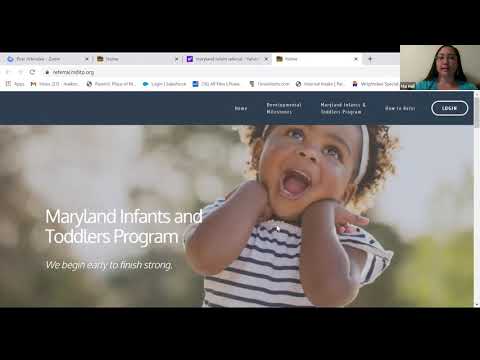
An MITP referral can come from anyone: a parent, a pediatrician, a NICU social worker, a daycare director, or a concerned grandparent. There’s a statewide online referral portal, and every Local Lead Agency also accepts phone and fax referrals directly.
Each jurisdiction handles intake through its own agency. Baltimore City ITP runs through Baltimore City Public Schools. Howard County ITP operates under HCPSS. Montgomery County ITP, Prince George’s County ITP, Anne Arundel County ITP, Frederick County ITP, and the other 19 jurisdictions each have separate intake numbers and provider pools. Quality is generally high statewide, but caseloads and discipline-specific wait times differ. Families relocating inside Maryland keep their IFSP and transfer to the new county’s lead agency.
The Age-3 Transition to Preschool Special Education
At 36 months, MITP ends. Children move to Part B preschool special education through their local school district under Child Find. The transition meeting must happen at least 90 days before the third birthday.
Some children qualify for Maryland’s Extended IFSP Option, which continues MITP-style services until the school year following the fourth birthday for those also eligible for preschool special education. This is also the most common point at which families add or scale up early intervention ABA to fill the hour gap left by the school day.
MITP vs. Private ABA: What Each Side Actually Does
The two systems are complements, not substitutes. A quick side-by-side:
|
Feature |
MITP | Private ABA |
| Cost |
Free |
Insurance or Medicaid |
| Age range |
Birth to 3 (Extended IFSP can go further) |
Often birth through teens |
| Weekly hours |
1 to 4 typical |
10 to 40 typical |
| Model |
Developmental, relationship-based |
Applied behavior analysis |
| Setting |
Home and natural environments |
Home, clinic, or both |
| Provider |
County-assigned therapists |
BCBA-led teams (see our services) |
Research from Geraldine Dawson and colleagues at Duke University showed that toddlers receiving structured early behavioral intervention made measurable gains in IQ and adaptive behavior compared with community-as-usual care (Dawson et al., 2010). That’s why so many Maryland families run MITP and private ABA in parallel.
A Real Family’s Path Through MITP
A Howard County mother noticed her 18-month-old wasn’t pointing, was barely babbling, and rarely responded to his name. Her pediatrician ran an M-CHAT-R and flagged elevated risk. She called Howard County ITP that afternoon. Within 6 weeks, the team finished evaluations and built an IFSP with weekly speech therapy and bi-weekly developmental instruction. At 24 months, an autism evaluation confirmed the diagnosis. She layered in 20 hours of private ABA through insurance, similar to what’s outlined in our walkthrough of ABA in Baltimore. By the 33-month transition meeting, his expressive vocabulary had grown from zero to more than 75 words and he was initiating play with his older sister.
Working through MITP paperwork while figuring out where private ABA fits is its own kind of full-time job. Our clinicians help families across Maryland and Virginia line up what the IFSP team is delivering with what intensive ABA can add, especially as the 3-year transition gets closer. Start a conversation with our team and we’ll walk through eligibility timelines, service gaps, and a realistic plan before age 3 arrives.
FREQUENTLY ASKED QUESTIONS
Q: What is the Maryland Infants and Toddlers Program?
A: MITP is Maryland’s free, Part C early intervention system for children birth to age 3 with developmental delays, atypical development, or qualifying medical conditions.
Q: Who qualifies for Maryland infants and toddlers eligibility?
A: Children with a 25% delay in any developmental area, atypical development, an established condition like Down syndrome, or qualifying risk factors such as very low birth weight.
Q: How do I make an MITP referral?
A: Submit one through the statewide portal at referral.mditp.org or call your county’s Local Lead Agency directly. Anyone can refer, including parents.
Q: Does MITP cover ABA therapy?
A: No. MITP follows a developmental model and does not deliver ABA directly. Families wanting ABA generally access it through private insurance or Maryland Medicaid alongside MITP.
Q: How long does the MITP referral process take?
A: Federal law caps it at 45 calendar days from referral to a finalized IFSP. Maryland Local Lead Agencies generally hit that deadline.
Q: Can my child get both MITP services and private ABA at the same time?
A: Yes. Many Maryland families run MITP-funded speech, OT, and PT alongside privately funded ABA hours, coordinated through the IFSP team.
Sources:
https://sites.ed.gov/idea/regs/c
https://marylandpublicschools.org/programs/Pages/Special-Education/MITP/index.aspx
https://news.maryland.gov/msde/mitp-2025/
https://publications.aap.org/pediatrics/article/145/1/e20193447/36917
https://publications.aap.org/pediatrics/article/125/1/e17/72797