Elementary school graduation ceremonies are not part of a normal school day. For a lot of autistic students, that alone makes them hard. New sounds, unfamiliar schedules, a gown that itches, a crowd that will not stop moving. None of that has anything to do with whether a child is ready to graduate from elementary school. It has everything to do with whether the environment is ready for the child, which is exactly the kind of planning our ABA therapy team builds into a student’s goals months before the event.
Elementary school graduation accommodations for autism are the planned adjustments that make a ceremony accessible for young autistic students: things like noise control, flexible participation, sensory-friendly clothing, and extra adult support. In short, these accommodations mean the student gets to be there, safely and on their own terms, without the day undoing months of progress. High school graduation calls for a different set of supports, which we cover in a separate guide.
What Elementary School Graduation Accommodations Actually Look Like

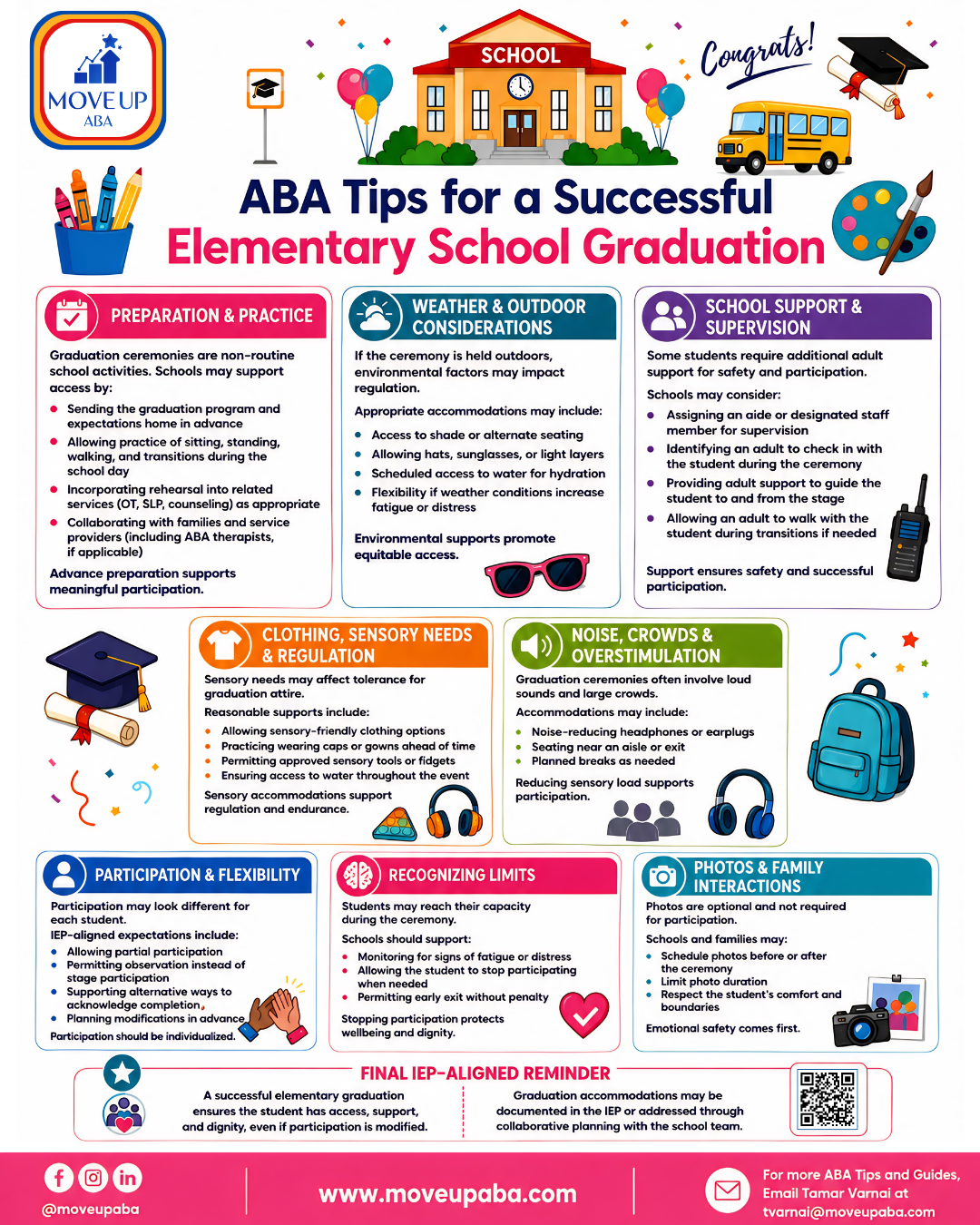
With autism now identified in roughly 1 in 31 children, most elementary school graduations will include at least one student who needs a different kind of plan. Every student is different, so elementary school graduation accommodations for autism are never one-size-fits-all. They are usually built around a few categories: preparation before the event, sensory supports during it, and flexibility in how a young student participates. A student who struggles with transitions might need a walked-through rehearsal. The one who sensitive to sound might need noise-reducing headphones. And the one who tires quickly might need permission to sit out part of the ceremony without penalty.
The Individuals with Disabilities Education Act requires that students with disabilities be able to participate in the same extracurricular activities requirement that covers events like an elementary school graduation, alongside their peers to the extent appropriate. IEPs must also spell out any supplementary aids and supports a student needs to take part in those activities, which is where graduation planning and everyday IEP goals overlap. Graduation accommodations for autism are one practical way elementary schools meet that requirement.
Preparing Before the Elementary School Ceremony
Rehearsal removes a lot of the unknown for a young student. Before the ceremony:
- Send the graduation program and a description of what to expect home in advance, so the family can walk through it together.
- Practice the specific physical sequence: sitting, standing, walking to the stage, and transitioning back to a seat.
- Build a short rehearsal into related services, including occupational therapy, speech-language sessions, or ABA sessions, if that is part of the student’s plan.
- Loop in families and any outside providers early, so everyone is working from the same expectations.
This kind of advance preparation is one of the most reliable ways to support meaningful participation for elementary-age students on the day itself, and it looks a little different for Maryland families than it does for those coordinating with Virginia schools.
Managing Noise, Crowds, and Sensory Overload at an Elementary Ceremony
Elementary school graduation ceremonies are loud by design. Applause, a PA system, a packed auditorium, younger siblings running the aisles. Sensory features, including sound and touch sensitivities, are reported in roughly three in four autistic children, which makes this one of the most common accommodation needs at any elementary school event.
A sensory-friendly elementary graduation ceremony can include:
- Noise-reducing headphones or earplugs for students who are sound-sensitive, the same noise-canceling headphones that many families already keep on hand for errands or car rides
- Seating near an aisle or exit, so a student can step out without disrupting the room
- Planned breaks built into the schedule rather than left to chance
- Sensory-friendly clothing options, or time to practice wearing a cap and gown before the actual day
- Shade, alternate seating, or scheduled water access if the ceremony is outdoors
Clothing deserves its own mention. A stiff gown or an unfamiliar cap can be genuinely distracting for a young student with tactile sensitivities. Letting a student practice wearing the outfit ahead of time, or approving a sensory-friendly substitute, often prevents a meltdown before it starts. The same sensory-friendly shopping principles that help in a busy store apply just as well to a packed elementary school auditorium.
Photos are optional, not a requirement of participation. Many families and elementary schools choose to schedule photos before or after the ceremony instead of during it, and to keep photo time short. A student’s comfort and boundaries come first, even during a celebration.
Staff Support and Supervision for Younger Students
Elementary-age students often do better with a specific adult assigned to them for the day, someone who checks in, helps with transitions, and walks with them to and from the stage if needed. This does not have to be complicated. It can be as simple as a designated staff member with a walkie-talkie, ready to step in if a student needs a break or gets separated from the group. Supervision planning matters most for younger students prone to wandering off in a crowd, the same elopement in autism risk many families already manage in stores, parking lots, or other busy public spaces.
Building In Real Participation and Flexibility

IEP accommodations for elementary graduation day should reflect the same individualized approach used in the classroom all year. That might mean:
- Allowing partial participation, such as walking across the stage but skipping a longer group activity
- Permitting a student to observe rather than stand on stage, if that is what works better
- Supporting an alternative way to mark the milestone, if the ceremony itself is not a good fit
- Planning these modifications in advance, not deciding in the moment
Recognizing limits matters just as much as planning ahead. If a young student shows signs of fatigue or distress mid-ceremony, stopping participation early protects their wellbeing and their dignity. An early exit is not a failure. It is the accommodation working as intended.
When to Loop In the Elementary School Team
Graduation accommodations can be documented directly in a student’s IEP or handled through collaborative planning with the elementary school team closer to the event. Either way, the earlier the conversation starts, the more options are on the table, and that window keeps opening as autism prevalence data climbs and more schools build these supports into standard graduation planning. A successful elementary school graduation should give a student access, support, and dignity, even if their version of participation looks different from their classmates’.
Want Every Step in One Place You Can Hand to the School?
- 📄 Download the free Elementary Graduation Accommodations Guide — a one-page cheat sheet to print or share with teachers, aides, and school staff.
- 🔗 Explore more free autism resources from Move Up ABA.
A smoother elementary school graduation day is easier to plan with a team behind you. Move Up ABA’s BCBAs can build ceremony-day goals right into your child’s ongoing ABA therapy plan. We provide in-home ABA therapy across Maryland and Virginia. Contact our intake team to get started. No waitlist.
FAQs
What accommodations help autistic students at elementary school graduation ceremonies?
Common accommodations include noise-reducing headphones, seating near an exit, planned breaks, sensory-friendly clothing, and a designated staff member for support.
Can a young student skip part of an elementary graduation ceremony?
Yes. Partial participation, such as walking the stage but skipping a longer group activity, is a valid IEP-aligned accommodation.
How do I request sensory accommodations for an elementary graduation?
Bring the request to the IEP team or elementary school administration well before the event, since accommodations documented in advance are easier to implement smoothly.
What if my child gets overwhelmed during the elementary ceremony?
Allow an early exit without penalty. Stopping participation when a student shows fatigue or distress protects their wellbeing and is part of the plan, not a failure of it.
Sources: