Sleep tips for special needs children start with one order of operations: rule out medical causes first, then build consistency. The most effective sleep tips and support for special needs children combine a physician check-up, a predictable bedtime routine, consistent sleep and wake times, less stimulation before bed, sensory-friendly conditions, and reinforcing independent sleep skills—often with help from a BCBA. Together, these layers help kids fall asleep faster and stay asleep longer.
Sleep struggles are extremely common, and they are not a sign of bad parenting. Clinically significant sleep problems affect over 80% of children with autism—two to three times the rate in typically developing children (Sleep and Autism review, 2023). The good news: behavioral strategies work, and they are the recommended first step.
How Much Sleep Does Your Child Need?
Knowing the target helps. The American Academy of Sleep Medicine, endorsed by the American Academy of Pediatrics, recommends these amounts of sleep per 24 hours (AASM):
- Infants (4–12 months): 12–16 hours, including naps
- Toddlers (1–2 years): 11–14 hours, including naps
- Preschoolers (3–5 years): 10–13 hours, including naps
- School-age (6–12 years): 9–12 hours
- Teens (13–18 years): 8–10 hours
These are general targets, and individual needs vary. But regularly getting fewer hours than recommended is linked to attention, behavior, and learning problems—which is why closing the gap matters.
Why Sleep Is Harder for Special Needs Children
Poor sleep does not just make the next day tired. Sleep difficulties are one of the most common reasons families of autistic children seek support, and the effects ripple into the day. Research links chronic sleep problems in autism to more aggression, hyperactivity, and emotional dysregulation—and even a 30-minute nightly shortfall can hamper how a child functions. The flip side is encouraging: when sleep improves, daytime behavior often improves too.
Several barriers commonly get in the way:
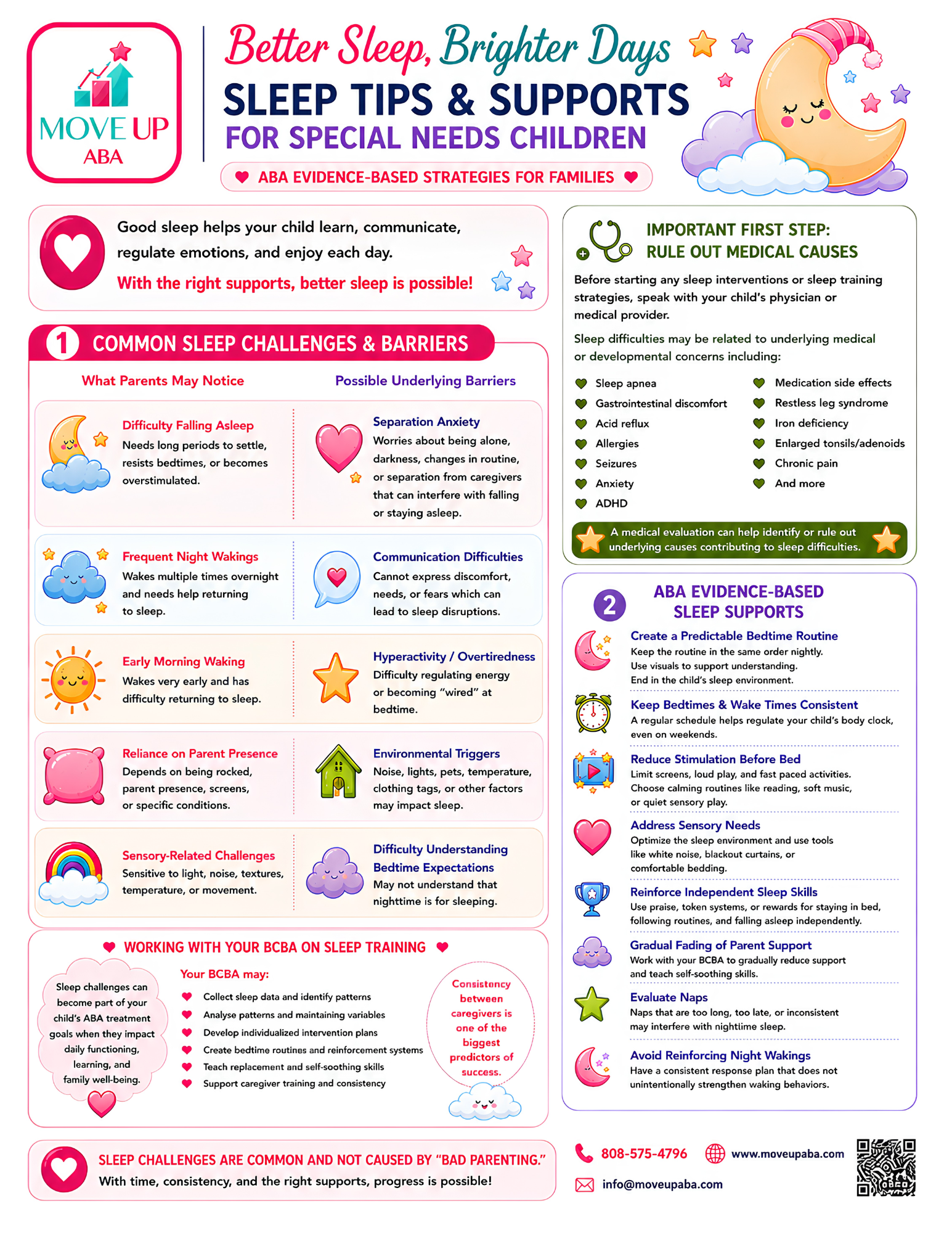
- Sensory sensitivities—light, noise, textures, or temperature.
- Separation anxiety and worries about the dark or being alone.
- Communication difficulties that make it hard to express discomfort or fear.
- Hyperactivity or overtiredness—becoming “wired” at bedtime.
- Environmental triggers like clothing tags, pets, or a warm room.
- Difficulty understanding that nighttime is for sleeping.
None of these mean better sleep is out of reach. They mean the plan has to fit the child.
First, Rule Out Medical Causes
This is the step families often skip—and it matters most. Before starting any sleep training, talk to your child’s physician. Sleep difficulties can be driven by treatable medical issues, including:
- Sleep apnea and enlarged tonsils or adenoids
- Acid reflux or gastrointestinal discomfort
- Restless leg syndrome and iron deficiency
- Allergies, seizures, chronic pain, or medication side effects
A medical evaluation can identify or rule out these underlying causes. Behavioral strategies work best once medical barriers are addressed—and experts recommend trying behavioral approaches before turning to supplements like melatonin, which should only be used with a doctor’s guidance (Kennedy Krieger Institute).
Sleep Tips for Special Needs Children: ABA Evidence-Based Supports
Clinical guidelines recommend behavioral sleep interventions as the first-line approach for sleep problems in autism, and systematic reviews find them effective for both falling asleep and staying asleep. They are low-risk and something families can begin at home. These are the core sleep tips for special needs children:
- Build a predictable bedtime routine. Keep the same order every night, use visuals, and end in your child’s sleep environment. Keep the whole routine under 30 minutes so it does not drag past bedtime.
- Keep bedtimes and wake times consistent—even on weekends—to regulate the body clock.
- Reduce stimulation before bed. Limit screens, loud play, and fast-paced activities. Choose calming routines like reading, soft music, or quiet sensory play.
- Address sensory needs. Optimize the room with white noise, blackout curtains, or comfortable bedding.
- Reinforce independent sleep skills. Use praise, token systems, or rewards for staying in bed and falling asleep independently.
- Gradually fade parent support. Slowly reduce your presence and teach self-soothing—ideally with a BCBA’s help.
- Evaluate naps. Naps that are too long, too late, or inconsistent can steal nighttime sleep.
- Do not reinforce night wakings. Use a consistent response plan that does not accidentally strengthen waking behaviors.
Consistency is the engine that makes every one of these strategies work.
Working With Your BCBA on Sleep
When sleep problems affect daily functioning, learning, or family well-being, they can become part of a child’s ABA treatment goals. A BCBA may:
- Collect sleep data and identify patterns.
- Analyze what triggers and maintains the problem.
- Develop an individualized intervention plan.
- Build bedtime routines and reinforcement systems.
- Teach replacement and self-soothing skills.
- Coach caregivers so everyone responds the same way.
That last point is key. Consistency between caregivers is one of the biggest predictors of success. When everyone follows the same plan, progress comes faster and lasts longer.
The Bottom Line
Sleep challenges are common, and they are not caused by “bad parenting.” With time, consistency, and the right support, progress is possible. Rule out medical causes, build a predictable routine, address sensory needs, and reinforce independent sleep—and lean on your care team when you need to. Better sleep really is within reach.
Take These Sleep Tips With You
Want every step in one place you can pin to the fridge?
- 📄 Download the free Sleep Tips & Supports guide—a one-page ABA cheat sheet to print or share with caregivers and sitters.
- 🔗 Explore more free autism resources from Move Up ABA.
Sleep is easier to solve with a team behind you. Move Up ABA‘s BCBAs can build sleep goals right into your child’s ABA therapy plan. We provide in-home ABA therapy across Maryland and Virginia. Contact our intake team to get started—no waitlist.