For an autistic child, a house of worship can be a hard place to be. Bells ring. Voices rise in song. Everyone stands, sits, then stands again. A house of worship asks a lot of a young nervous system all at once. It can also become a place of belonging.
Autism and places of worship come together most smoothly when families prepare early, use visual supports, practice the routine at home, and ask for small accommodations. The hard parts, loud sounds, long stretches of sitting, crowded rooms, and unfamiliar rituals, are predictable reactions to a complex environment, not behavior problems. With planning and individualized support, worship and religious education can be positive, inclusive experiences.
Autism and Places of Worship: Why These Spaces Feel Overwhelming
Faith spaces pack many demands into a short window. For autistic children, several of them land hard at once.
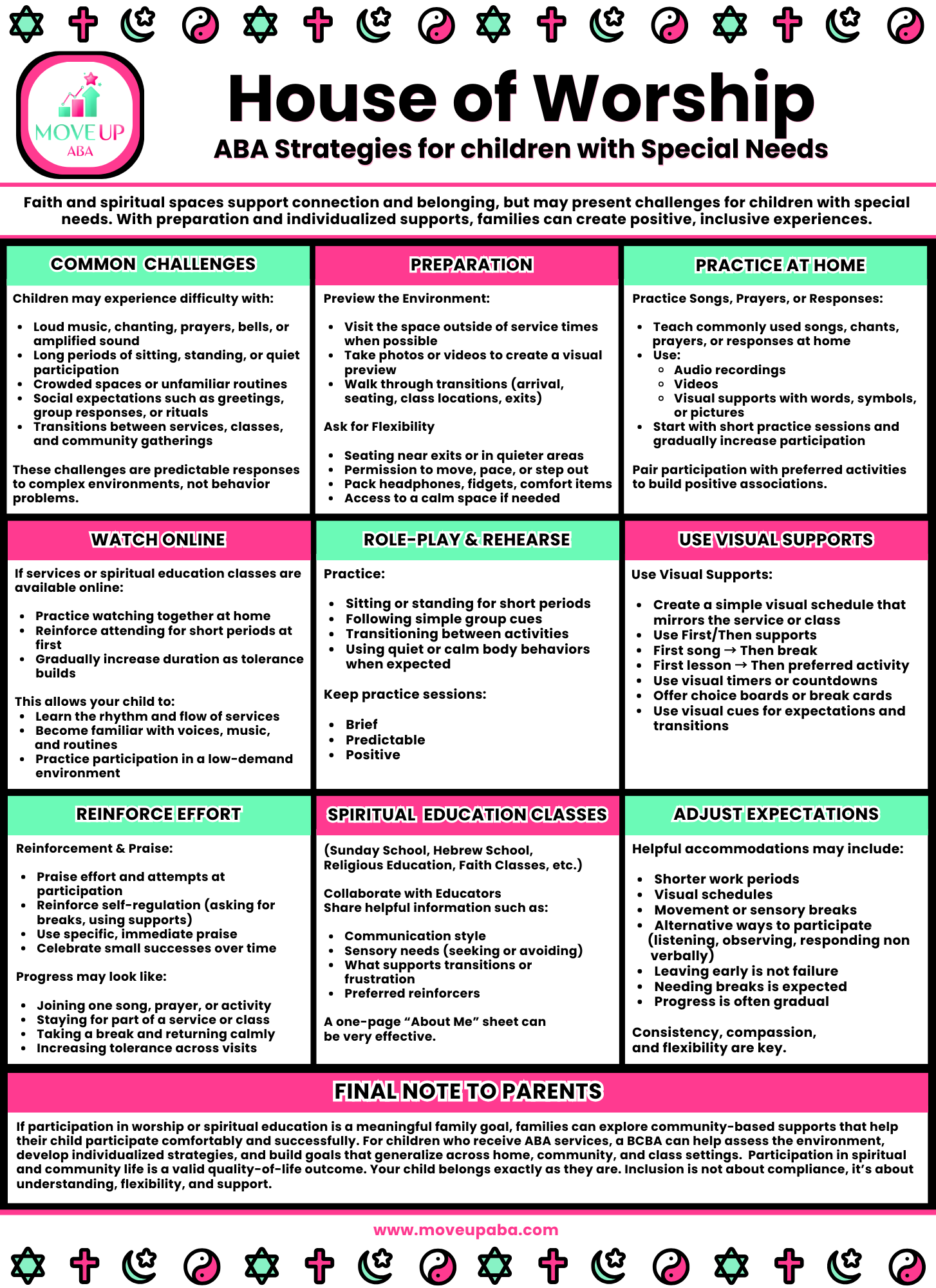
Common challenges include:
- Loud music, chanting, bells, or amplified sound
- Long periods of sitting, standing, or staying quiet
- Crowded rooms and unfamiliar routines
- Social expectations like greetings, group responses, and rituals
- Transitions between the service, classes, and community gatherings
Every child is different. One child freezes at the sound of singing. Another paces because sitting still feels impossible. A third does fine in the service but struggles the moment class starts. Knowing your child’s specific triggers is the first real step, because the plan follows the profile, not the other way around.
Research on autism points to sensory over-responsivity, a heightened reaction to everyday input like noise and touch, as a common feature. Reviews of light and sound sensitivity find that sudden or loud sounds and certain lighting can trigger strong reactions in autistic people. So a bright sanctuary with a booming organ is not a small ask.
None of this is misbehavior. When the input becomes too much, a child may hit sensory overload and need to step away.
Preview and Prepare Before You Go
Taking an autistic child to church, synagogue, mosque, or temple starts well before the service. Preview the space while it is quiet.
Try this:
- Visit outside of service times so the room feels familiar
- Take photos or short videos to build a visual preview
- Walk through the whole sequence: arrival, seating, classrooms, exits
- Pack headphones, a fidget, and a comfort item
- Ask about seating near an exit or a quiet spot to reset
A simple visual schedule that mirrors the service helps a child know what comes next. Picture cards, a first-then board, or a short countdown all shrink the surprise factor. Studied as visual activity schedules, these tools have a solid research base for building independence and easing transitions.
Preparing an Autistic Child for Religious Services at Home
Preparing an autistic child for religious services works best in small, low-pressure doses at home. Familiar songs and routines feel safer once your child has met them already.
Practice ideas:
- Teach common songs, chants, prayers, or responses using audio, video, or picture cards
- Rehearse sitting or standing for short stretches, then build up
- Role-play group cues and quiet-body moments
- If services stream online, watch together and reinforce short viewing times
Visual supports are not a gimmick. They are an evidence-based practice for autistic learners, backed by more than a hundred studies. Pair each practice run with something your child enjoys so participation builds positive associations.
Smooth transitions matter too. Moving from the car to the lobby to a classroom is a lot of change in a few minutes, and transition planning makes it easier. Our team builds these skills step by step, in the settings where families actually need them.
Keep the plan close. Our one-page House of Worship strategy sheet gathers these steps into a printable you can bring to services or hand to a class teacher, and you will find it with our other free tools on the resources page.
Reinforce Effort and Expect Breaks
Praise the effort, not just the outcome. Specific, immediate praise works better than a vague “good job,” and positive reinforcement is one of the most established tools in autism support.
What to reinforce:
- Attempts to participate, even partial ones
- Self-regulation, like asking for a break or using a support
- Small wins that add up over visits
Progress often looks gradual. Joining one song. Staying for part of a class. Taking a break and coming back calm. Leaving early is not a failure, and needing breaks is expected. Planned sensory breaks give a child a way to reset before overwhelm takes over.
A real example from our sessions: a family wanted their son to sit through part of a weekly service. We started with two minutes in an empty sanctuary, paired with a favorite fidget, then added a first-then card and a quiet exit plan. Over several weeks he built up to staying for the opening songs, then stepping out with a caregiver before the room got loud. The goal was never a perfect sit. It was a calm, repeatable win he could grow from.
Toward Sensory-Friendly Worship and Faith Classes
Sensory-friendly worship services are not a special favor. They are good design that helps many families, not only yours.
Faith classes like Sunday school and Hebrew school come with their own demands, so a quick chat with the teacher goes a long way. Share the essentials:
- How your child communicates
- Sensory needs, whether seeking or avoiding
- What helps with transitions or frustration
- Preferred reinforcers
A one-page “About Me” sheet makes this easy for volunteers to follow, especially in classes staffed by rotating helpers who may not know your child yet. Helpful accommodations include shorter work periods, visual schedules, movement breaks, and non-verbal ways to take part, like listening or observing.
Belonging in a community of faith is a real quality-of-life outcome, and research on congregational inclusion shows that small, intentional supports are what make it happen. Studies also connect taking part in community life to stronger family quality of life. Consistency, compassion, and flexibility carry the day. Your child belongs exactly as they are. Inclusion is about understanding and support, not compliance.
Worship should feel like belonging, not a test your child has to pass. If joining services or a faith class is a goal for your family, our team in Marlyand and Virginia can build the visual supports, practice plans, and step-by-step goals that make it realistic. Connect with our team and let’s map out what participation could look like for your child, one small win at a time.
FAQs
How does autism affect a child in places of worship?
Autism and places of worship can clash because of loud sound, crowds, long sitting, and unfamiliar routines. These are sensory and predictability challenges, not misbehavior.
How do I take an autistic child to church for the first time?
Preview the space while it is quiet, pack sensory tools, and use a visual schedule. Start with a short visit and build up over time.
What are sensory-friendly worship services?
They are services adjusted for comfort, with lower volume, softer lighting, flexible seating, and freedom to move or step out as needed.
Can ABA therapy help my child join Sunday school or Hebrew school?
Yes. A BCBA can assess the setting, build visual supports and practice routines, and set goals that carry over from home to class.
Is it okay to leave a religious service early with my autistic child?
Absolutely. Leaving early is a success, not a failure, and it helps your child return with a calmer, more positive association.
Sources:
- https://www.ncbi.nlm.nih.gov/pmc/articles/PMC9601143/
- https://www.frontiersin.org/journals/psychiatry/articles/10.3389/fpsyt.2026.1771956/full
- https://pubmed.ncbi.nlm.nih.gov/25081593/
- https://afirm.fpg.unc.edu/wp-content/uploads/Visual-Supports-Brief-Packet.pdf
- https://afirm.fpg.unc.edu/wp-content/uploads/Reinforcement-Brief-Packet-Sam-AFIRM-Team-Updated-2024.pdf
- https://doi.org/10.1177/0014402915598773
- https://doi.org/10.1352/1944-7558-120.5.395